
The Corporate Ladder Broke. Women Built Their Own.
Women now hold more payroll jobs than men in America. Business ownership is catching up.
November 10, 2026

Share
I love my role as a mentor at SCORE. Every week, I get to talk with two or three entrepreneurs, some just getting started, others navigating changes in a business they've already built. The part I love most is hearing their passion for what they want to do, and seeing how committed they are to their own ideas.
Every so often, I like to look back across all those conversations and see if any patterns emerge. This year, I noticed something that made me stop and dig in: well over half my sessions have been with women entrepreneurs.
The more I sat with it, the less it should have surprised me.
I Shouldn't Have Been Surprised
Women now earn the majority of college degrees at every level: 58.5% of bachelor's degrees, 62.8% of associate degrees, 62.6% of master's degrees, and 57% of doctoral degrees. That gap has been widening for decades, not narrowing.
And just recently, something else crossed a threshold that hadn't crossed in generations. Women now hold more payroll jobs than men in the United States. It's only happened twice before in recorded history, briefly during the Great Recession and again just before COVID, and both times it reversed within a year or two. This time, economists say it's structural, not cyclical. Laura Ullrich, a former regional economist at the Federal Reserve Bank of Richmond, put it this way: "This seems to be more of a long-term decline that's led to more of a permanent shift going forward, or at least semi-permanent."
U.S. Bureau of Labor Statistics (BLS), Current Population Survey; BLS Women's Databook 2022
Where the new jobs are landing tells the rest of the story. Private education and health services, fields where women make up a clear majority of the workforce, added 999,000 jobs in 2024, essentially half of all U.S. job growth that year. Richard Reeves, the Brookings scholar who wrote Of Boys and Men, points out that nobody ever built a pipeline to pull men into these fields the way one was built to pull women into STEM. If anything, the training pipelines feeding healthcare and education are getting more female over time, not less.
BLS Monthly Labor Review, "Total nonfarm employment growth continues to slow in 2024"
So if more women are finishing school, and more women are working, why should business ownership be any different?
It Turns Out, It's Coming
A quarter of women say they plan to start a business this year, and 58% say they'd consider it within the next 12 months.
There's an honest caveat worth including here. Self-employment overall isn't exploding the way a lot of "everyone's a founder now" content claims. BLS's own numbers show unincorporated self-employment was actually down 2.5% year over year as of this June. But that makes the trend among women stand out more, not less. They're not riding a general gig-economy wave. They're a specific, deliberate shift inside a flat overall number.
The Right Ingredients, Already Tested
Here's what I've noticed sitting across the table from these women. Many of them arrive with the Underdog Principles already intact, not as something I need to teach them, but as something life already taught them.
A lot of them have already had their resolve tested, often by the exact kind of tradeoff a big company would never ask an employee to make: stepping back from a career track to have a child, then figuring out how to build something that fits the life they actually have instead of the one a corporate calendar assumes. That's Purpose and Positioning showing up before the business plan even exists. They already know what they're optimizing for, because they've had to defend that choice before.
Why This Matters
I don't think this is a story about who's winning and who's losing. It's a story about how much more varied American entrepreneurship is becoming, and that variety is a strength for everyone, not a footnote about one group.
A solopreneur optimizing for flexibility is solving a different problem than a founder chasing scale. A costume designer serving a niche community is positioned nothing like a wellness coach building recurring client relationships. Big companies need to appeal broadly to survive, which forces them toward the middle. The more different kinds of owners we have building different kinds of businesses, for different reasons, the more of the market gets served by someone who actually fits it, instead of someone settling for close enough.
An economy with more distinct value propositions in it is a more resilient economy. Not because any one of those businesses is bulletproof, but because they're not all vulnerable to the same thing at the same time. A recession that guts one industry doesn't touch another. A supply chain shock that flattens one business model barely registers for a different one three doors down. Diversity of ownership is diversity of exposure, and that protects all of us, not just the businesses themselves.
If You've Ever Thought You Had Something Worth Building
If you've been sitting on an idea because you didn't see yourself as "the entrepreneur type," I'd gently push back on that. The data says the person building the next great small business is less predictable than it used to be, not more. The room is genuinely wider than you think.
You don't need to look like the founders on magazine covers. You need something unique to offer and the willingness to test it. If that's you, this is a good year to stop waiting for permission and start the conversation, with a mentor, with a co-founder, with yourself. That's exactly the conversation I get to have every week, and it never gets old.
Enjoyed this article?
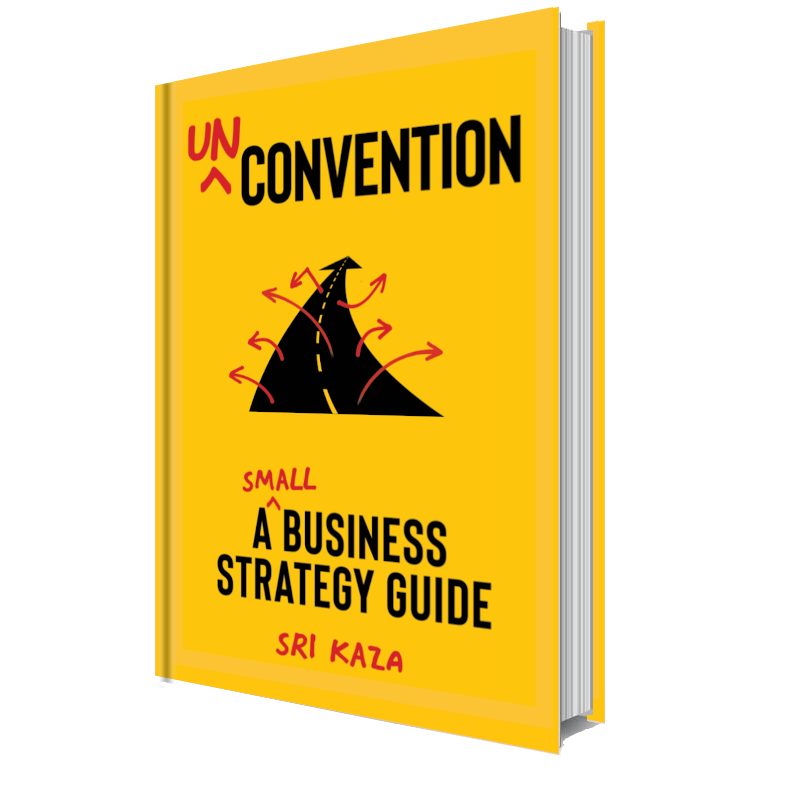
These ideas come from Unconvention — Sri Kaza's guide to competing smart as a small business.
Copyright 2026
Sri Kaza