
Small Business AI Adoption: Stats vs. Strategy in 2025
Last year everyone asked if you were using AI. The question now is what you're doing with it.
July 8, 2026
Share
A client of mine, a large enterprise (not a small business), spent the better part of last year doing what a lot of organizations did: issuing mandates. Use AI. Explore AI. Find ways to integrate AI into your work. The directive was genuine. The support behind it was thin. And the results were mostly what you'd expect when you tell a large organization to do something new without telling them how or why: polite compliance, surface-level experimentation, and a lot of shrugging.
Then something changed. One employee, not a developer, not on the technology team, built a functioning app from a concept that IT had estimated would take a year to produce. It worked. The company celebrated it publicly. And adoption took off.
Not because the tools got better overnight. Because the example made the possibility real.
I work with large enterprises, and I mentor small business owners. The dynamic plays out differently at different scales, but the underlying pattern is the same. The question a year ago was "are you using AI?" Most people weren't sure how to answer, or what would count as a yes. The question now is different. "What are you doing with it, and what is actually helping?" That shift in framing is where the real conversation starts.
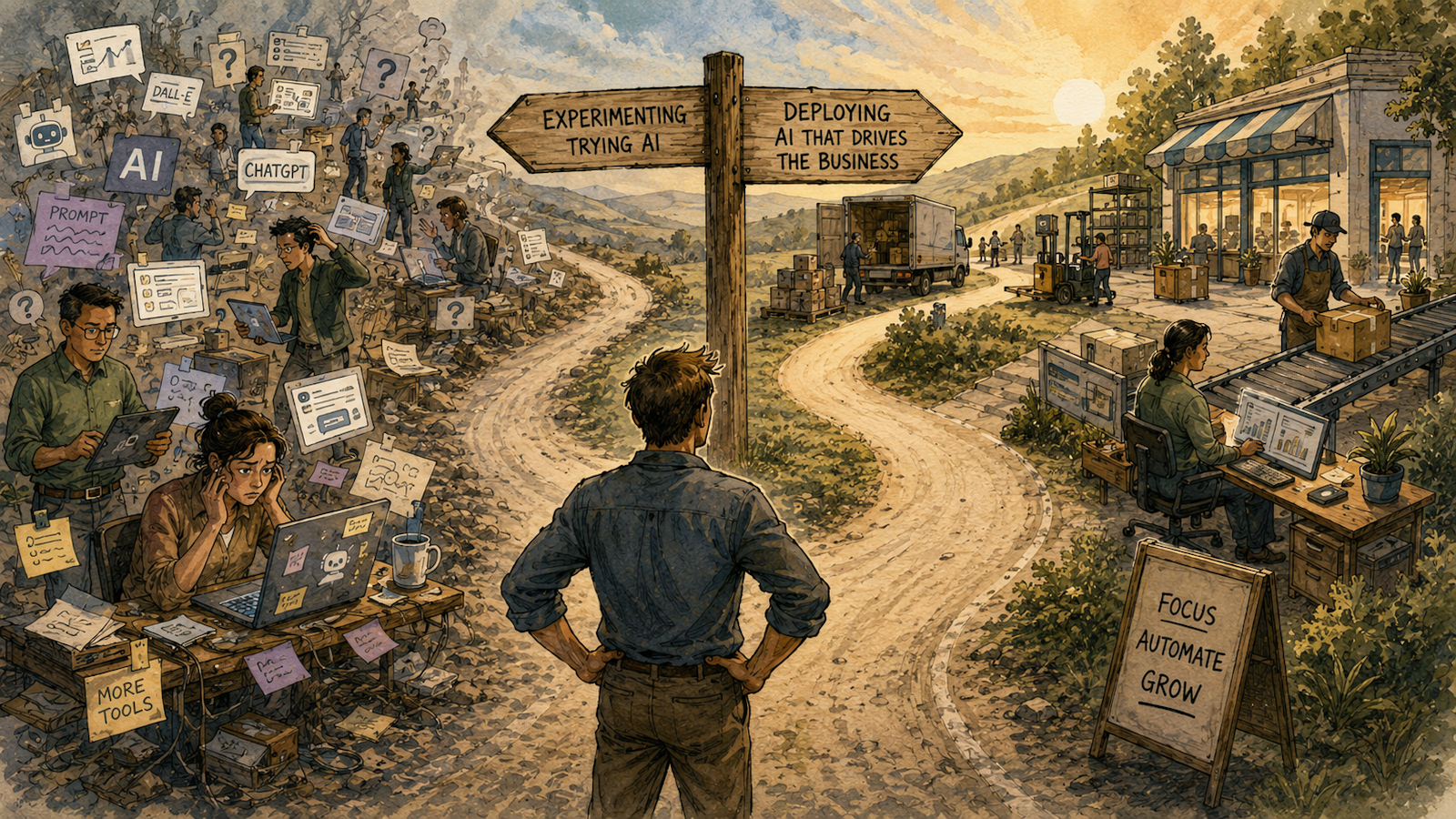
The Gap Between Experimenting and Deploying
The Census Bureau's Business Trends and Outlook Survey puts production AI use among small businesses at 8.8%. Thryv's national survey of small business owners puts AI adoption at 55%. Both are right. They're measuring different things.
The Census Bureau counts AI integrated into the actual production of goods or services. The vendor survey counts anyone who's opened an AI tool in the past year. The gap between those two numbers: 8.8% versus 55%. This isn't a data discrepancy. It's the distance between experimenting and deploying.
Most small businesses are somewhere in that gap right now: curious, occasionally using tools, but not yet running anything that would qualify as operational. That's not a failure. That's where the enterprise world was two years ago.
The more interesting data point is the trajectory. In early 2024, large businesses used AI at 1.8 times the rate of small firms. By mid-2025, that gap had shrunk dramatically, small business adoption was accelerating while large-firm adoption had plateaued. This reversal hadn't happened before in the history of technology adoption. With broadband, with cloud software, with mobile payments, large companies led and small businesses followed years behind. AI changed that, because the tools became cheap and accessible fast enough that the traditional lag nearly disappeared.
U.S. Census Bureau Business Trends and Outlook Survey (BTOS); Thryv Annual AI and Small Business Survey, 2025
Big Companies Use AI to Cut. Small Businesses Should Use It to Grow.
Here is where the enterprise story gets complicated, and where small businesses have something to learn from watching it play out.
In the largest technology companies, productivity gains from AI have started to show up in headcount decisions. Same output, fewer people. The efficiency is real, but the benefit flows upward, flowing to margins and shareholders. For most of the rest of the economy, including small businesses, that's not the model that makes sense. You're not trying to do the same with less. You're trying to do more with what you have.
That distinction matters for how you think about AI. The question isn't "what can I eliminate?" It's "what becomes possible that wasn't before?"
AI-using small businesses are saving between 5 and 15 hours per week on content-related work alone. At a modest $25 an hour, that's $6,500 to $19,500 in reclaimed time annually, from one category of use. But the business owners getting the most from AI aren't banking that time. They're redeploying it. More client relationships. More projects. More capacity to pursue partnerships or new revenue lines that kept getting pushed to the back burner because there was never bandwidth.
That's the version of AI productivity worth building toward: not shrinkage, but growth capacity. The question shifts from "how do I use AI?" to "what would I do with 10 more hours a week that I can't do today?"
The Trap Is Real, and It Has a Name
The businesses that are struggling with AI aren't mostly the ones ignoring it. They're the ones chasing it.
A new scheduling tool. A new content generator. A new customer chat widget. Each requires time to evaluate, set up, and integrate. Each introduces decisions about data, pricing, and workflow. And most of them never get used consistently enough to generate any real return before the next one comes along.
Among the small businesses with no current AI adoption plans, 62% say they lack understanding of what AI can actually do for their business. That's a reasonable response to an overwhelming amount of noise. When every vendor claims their product will transform your operations, skepticism is a sensible starting point.
The answer isn't less skepticism. It's more specificity.
AI is not a strategy. It's a category of tools. The question isn't "should I be using AI?" The question is: "What is the single most time-consuming thing I do every week that requires no real judgment, and can something else do it instead?" That's the entry point. Everything else is distraction.
Growth Productivity: What It Actually Looks Like
The employee who built the app that IT said would take a year didn't have a strategy. They had a problem they were tired of working around, and a tool that turned out to be capable of solving it. The insight that followed, celebrated publicly, wasn't "AI is impressive." It was "this changes what's possible."
That recalibration is what small businesses are working toward now. Not adoption as a checkbox. Adoption as a way to expand what one person or a small team can actually accomplish.
The businesses getting there are running a handful of AI tools across different parts of the operation, across content, customer communication, scheduling, and financial reporting, not because they built a technology stack, but because they kept solving the next problem after solving the first one. The cumulative effect is what changes the business. A few hours here. A decision made faster there. A project that finally gets off the ground because there's capacity for it.
The enterprises that cracked this didn't do it with mandates. They did it with examples. The employee who built the app wasn't following a strategy. She had a problem she was tired of working around, and spent a weekend finding out if a tool could solve it.
That's the entry point for small businesses too. Not a technology plan. Not a vendor evaluation. One problem. One tool. Thirty days. Track what changes.
Pick the task you do every week that requires the least judgment and takes the most time. Draft emails, social posts, weekly reports, meeting summaries. Find a tool built specifically for that task, not a general-purpose assistant. Use it for a month and measure one thing: time before versus time after. If it works, you've just found your example. From there, the next problem is easier to see.
Enjoyed this article?
These ideas come from Unconvention — Sri Kaza's guide to competing smart as a small business.
Copyright 2026
Sri Kaza