
This Tariff Fight Was Never About Trade
It's about auto supply chains, dairy quotas, and who Canada answers to.
October 13, 2026
Share
Cindy Baldassi makes stone and glass jewelry out of her studio in Calgary. Three out of every four dollars she makes comes from American customers. As of August 22, a new 50% U.S. tariff applies to her products, and she's not being dramatic when she says what it means: "It's quite likely that it will wipe out most of my US sales. I expect that at least half of my business will be gone."
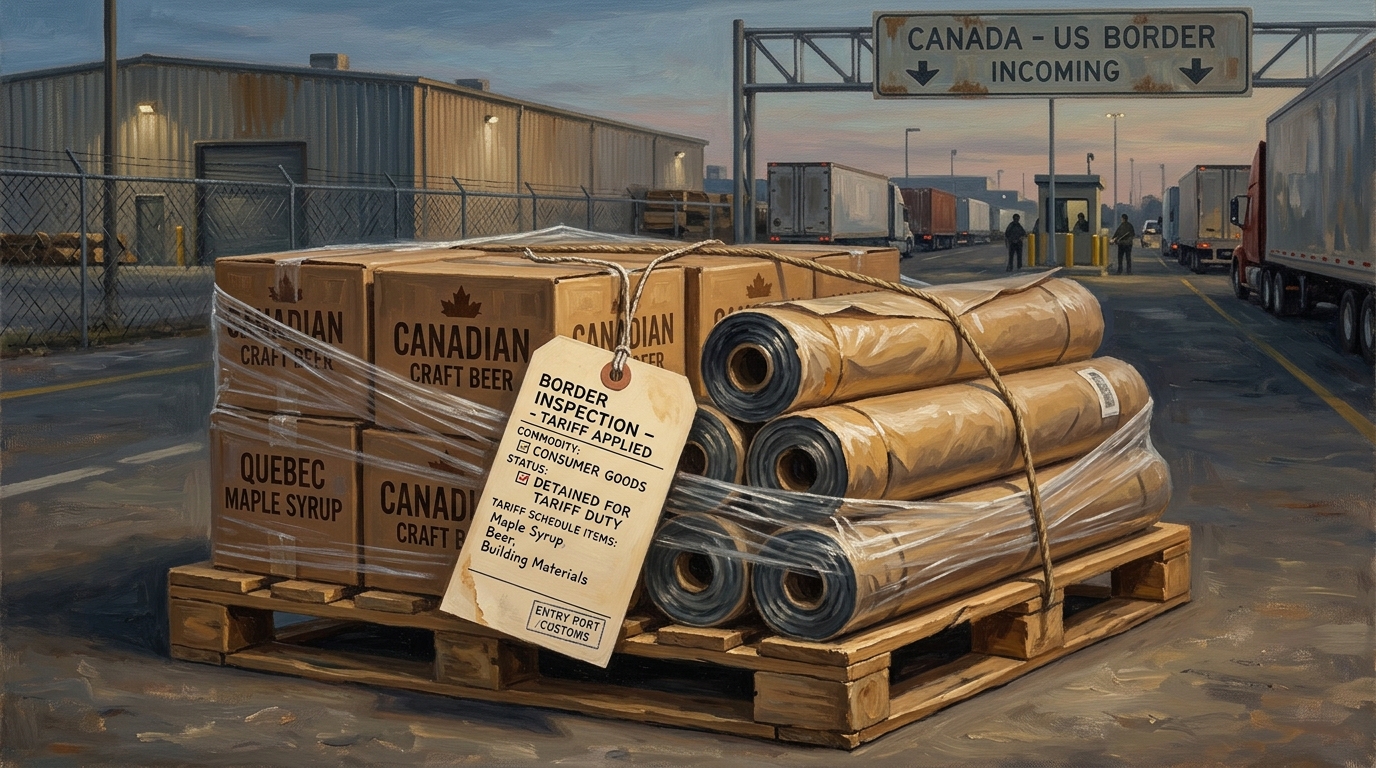
Her jewelry isn't a strategic industry. Neither is the hockey equipment, cement, beer, and clothing sitting on the same tariff list. That's worth sitting with for a second, because the fight that's actually happening between Washington and Ottawa has almost nothing to do with any of those things.
This Isn't About Hockey Sticks
On August 21, trade talks between the U.S. and Canada collapsed. The next day, the U.S. imposed 50% tariffs on roughly $20 to $28 billion of Canadian goods, using a rarely invoked 1930s legal authority that overrides Canada's protections under the USMCA trade agreement entirely. Canada matched it dollar for dollar on September 8, hitting more than 700 U.S. products.
Dan Kelly, who runs the Canadian Federation of Independent Business, put his finger on what's different about this round: previous tariff fights were about steel, aluminum, and cars, big commodities that hit big companies. This one lands directly on small business products. His members feel like "cannon fodder" in a fight that isn't really about them.
So what is it about?
What Carney Wouldn't Give Up
Canada's Prime Minister, Mark Carney, has been fairly direct about where the line was. The U.S. offered real concessions, cutting tariffs on steel, aluminum, autos, and softwood lumber, but attached to those cuts was a restructuring of Canada's auto sector that Carney says would have handed the U.S. supply chain coordination over Canadian manufacturing. His framing: the U.S. wants to "wipe out Canadian industries or make them subsidiaries."
There was also language in the collapsed deal limiting Canada's freedom to negotiate trade agreements with other countries, widely read as a demand that Canada align more tightly against China as the price of tariff relief. And Canada's decades-old dairy supply management system, the quota program that's protected small Canadian dairy farmers since the 1970s, was squarely in the crosshairs. The U.S. wanted Canada to change how import licenses get allocated so American milk and cheese could actually use the market access Canada had already promised on paper.
They asked too much, and they offered too little.
- Mark Carney
Prime Minister, Canada
What Trump Wants
Washington's version centers on fairness. USTR Jamieson Greer says the U.S. put real concessions on the table and Canada wanted more at the last minute. Trump has long treated Canada's dairy tariffs, which can exceed 200% above quota, as proof that the relationship is lopsided. His public framing was blunter: "Canada wants the benefits of being a State, without being one!!"
Underneath the tariff rate, the bigger prize is leverage. Deeper coordination over Canadian auto manufacturing and a constraint on Canada's outside trade relationships both point the same direction: pulling Canada's economy and its foreign policy more tightly into the U.S. orbit, at a moment when the U.S. is actively trying to consolidate allies against China.
The Real Fight
Carney is defending Canadian sovereignty over its own industrial and trade policy. Trump is using tariffs as leverage to fold Canada more fully into a U.S.-aligned economic bloc. Neither side is fighting over jewelry or hockey sticks. Small businesses like Cindy's are just where the pressure lands first, because hitting consumer-facing goods creates visible pain fast, while the actual argument, over auto supply chains, dairy protection, and geopolitical alignment, plays out over years.
The Lesson for Anyone Running a Business
I don't think the takeaway here is "tariffs are bad" or "pick a side." It's narrower than that, and it applies whether you're in Calgary or Cleveland: Cindy built a business where 75% of her revenue depends on one country's customers staying reachable on the terms that existed yesterday. That's not a mistake she made. It's a risk built into serving any market that concentrated, and it's exactly the kind of risk a decision made in Washington or Ottawa can flip overnight, with zero warning and zero input from her.
Positioning and Proximity are usually about picking your customers deliberately. They're just as relevant in reverse: knowing exactly how concentrated your revenue is in one customer base, one border, one policy environment, and deciding on purpose whether that's a risk you're comfortable holding, rather than one you backed into. Cindy didn't do anything wrong. She just found out the hard way how much of her business was riding on a relationship she didn't control.
Enjoyed this article?
These ideas come from Unconvention — Sri Kaza's guide to competing smart as a small business.
Copyright 2026
Sri Kaza