
Don't Trust Google with Your Business Listings
Why Your Business Listings Matter More Than You Think
January 28, 2026
Share
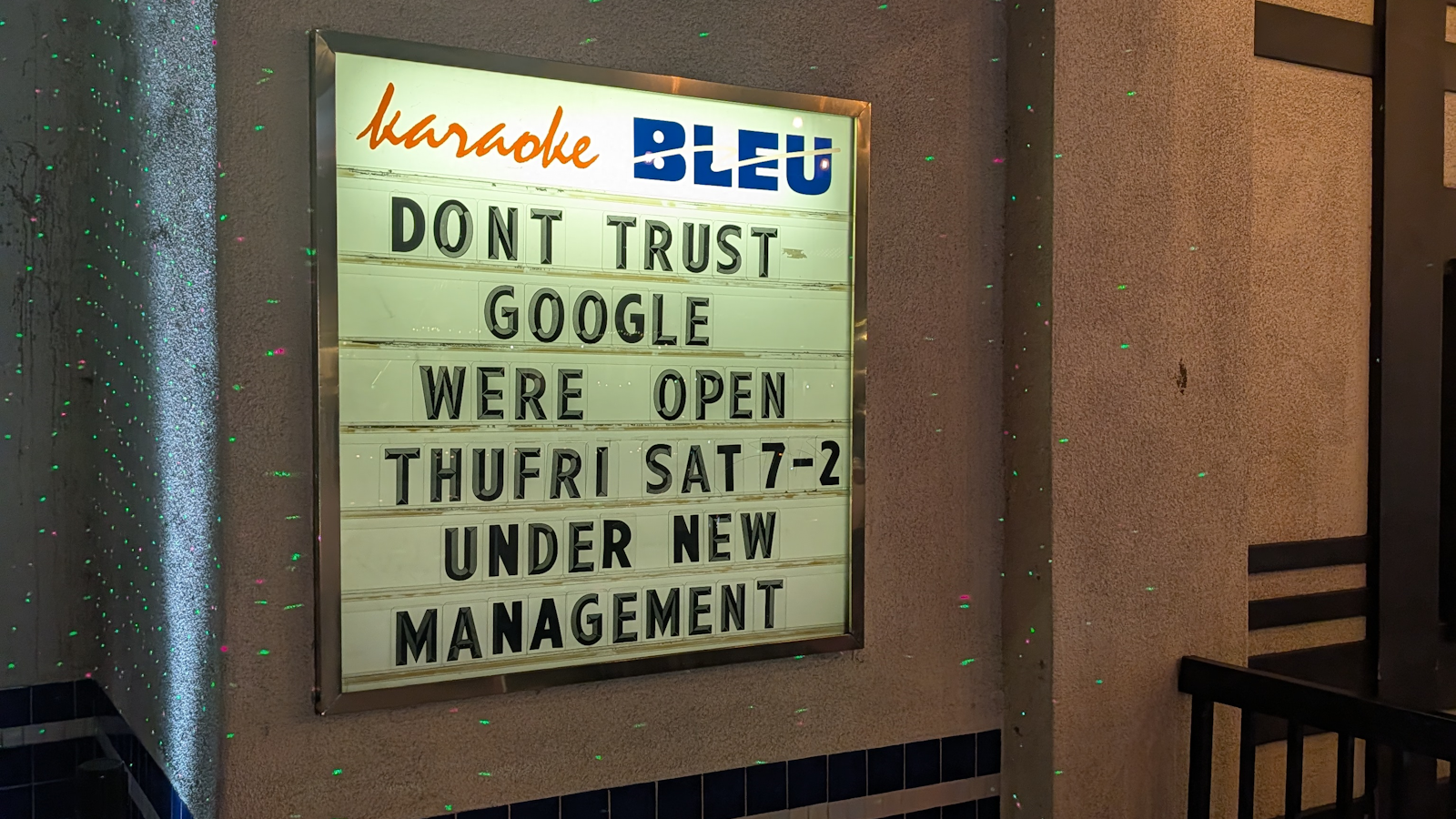
I was out to dinner with my family last weekend when I spotted something unusual on a building across the street. A karaoke bar had mounted a marquee sign with a message that caught my eye: "DONT TRUST GOOGLE / WERE OPEN / THUFRI SAT 7-2 / UNDER NEW MANAGEMENT"
Curious, I pulled out my phone and searched for "Karaoke Bleu". Google's first result was Yelp, showing: "KARAOKE BLEU - CLOSED - Updated January 2026". Ouch. Google maps had an indicator "Permanently Closed". Google is doing some serious harm to this business, and everyone in the neighborhood looking for a place to hit the high note of Aha's Take On Me.
Here's a business that had no choice to fight the problem. The misinformation was so negative and obviously wrong, they heard about it from actual customers. They had to fight it with a physical sign and I hope they also took the ten minutes to claim their free Google Business Profile.
I encounter incorrect online information a lot with small businesses, many owners believe these listings are automatic, and unimportant. They're wrong. Google, Yelp, and dozens of other platforms are the source of truth for many consumers. But without the owner managing what they say, they populate business profiles automatically using (often incorrect) public information.
Why Your Online Presence Matters More Than Ever
Today's customers don't just show up at businesses anymore. Before visiting a new restaurant, retail store, or service provider, they research online – and recent data shows this behavior has become nearly universal.
Sources: Wiser Review 2025, Visual Objects 2021, Statista 2024
The numbers tell a clear story: your online presence is likely the first impression most potential customers have of your business. And when that information is wrong – outdated hours, incorrect phone numbers, old addresses – you're not just missing opportunities. You're actively creating frustration that drives customers to competitors.
Each unclaimed listing represents multiple missed opportunities to:
- Correct inaccurate information before customers waste a trip
- Answer customer questions directly
- Respond to reviews (both positive and negative)
- Share high-quality photos that showcase your business properly
- Highlight what makes your business unique
- Update information about special hours, new services, or changes
When you don't manage these listings, you're essentially letting strangers control your digital first impression. Random visitors upload unflattering smartphone photos that become your visual identity. Old hours from five years ago send customers to locked doors. Unanswered questions push potential customers toward competitors who do respond.
The Real Cost of Unclaimed Listings
Sources: Wiser Review 2025, Hook Agency 2025, Visual Objects 2021
The data reveals something crucial: it's not enough to have a listing. Active management creates measurable business impact. Businesses that claim their listings and engage with customers through reviews, questions, and updates significantly outperform those that don't.
The Karaoke Bleu sign demonstrates they understand customers check Google. But by leaving their listing unclaimed, they're forcing every potential customer to make a choice: trust the sign or trust Google. Some will choose wrong and never show up.
Essential Business Listings Every Owner Should Claim
Start by claiming your business on these ten essential platforms:
- Google Business Profile – The most critical listing for local businesses. This controls how you appear in Google Maps and Google Search results. Claiming this profile lets you update hours, respond to reviews, post updates, and answer customer questions. With 81% of consumers checking Google before visiting, this should be your first priority.
- Yelp for Business – Despite mixed feelings some business owners have about Yelp, it remains powerful for customer reviews. Claiming your listing allows you to respond to reviews, update business information, and add high-quality photos that represent your business properly.
- Facebook Business Page (Meta Business Suite) – Customers may have already created unofficial pages for your business. Search for your business name and claim the official page through Meta Business Suite to control what information appears.
- Bing Places for Business – Less prominent than Google, but Bing Places ensures your business appears correctly in Microsoft's search engine and on Microsoft Maps, particularly important for customers using Windows devices.
- Apple Maps (via Apple Business Connect) – With millions of iPhone users relying on Apple Maps for directions, claiming your listing ensures Apple users find accurate information about your business location and hours.
- Better Business Bureau (BBB) – BBB listings often appear high in search results and signal credibility to potential customers. Claiming your profile allows you to respond to complaints and showcase your commitment to customer satisfaction.
- Nextdoor (Nextdoor Business) – This neighborhood-focused platform is increasingly important for local businesses. Claiming your listing ensures accurate information reaches neighbors specifically looking for local services.
- Foursquare – While less prominent than it once was, Foursquare data powers many other apps and services. Claiming ensures consistent information across the digital ecosystem.
- Yellow Pages (YP.com) – The digital version of the traditional Yellow Pages still holds value for local SEO and discovery, especially for older customers who trust this longtime resource.
- Industry-specific directories – Depending on your business type, claim listings on relevant platforms like TripAdvisor (hospitality), Angie's List (home services), OpenTable (restaurants), or Healthgrades (medical practices).
Before You Start: Information to Prepare
Having this information ready makes claiming your listings much smoother:
Basic Business Information
- Legal business name
- Physical address (exactly as it appears on your utility bills)
- Phone number
- Website URL
- Hours of operation (including special holiday hours)
- Year established
- Business category/industry (be specific)
- Brief business description (both short and long versions)
Verification Materials
- Business license or tax documents
- Utility bill showing your business address
- Smartphone to receive verification codes or record verification videos
- Domain-based email address (you@yourbusiness.com)
- Social security number or EIN (some platforms require this)
Marketing Assets
- High-quality logo in various formats
- Professional photos of your storefront, interior, products/services, and team
- Menu, service list, or product catalog
- Special attributes (wheelchair accessible, pet-friendly, etc.)
- Business attributes (free WiFi, parking, payment methods accepted)
Social Proof
- Testimonials you might want to highlight
- Awards or certifications
- Professional affiliations
Focus on What Matters Most
While I've listed ten important platforms, you don't need to devote equal attention to all of them. Start by asking your current customers how they found you. Did they search on Google? Check Yelp reviews? See you on Nextdoor? This information tells you which platforms deserve your immediate attention.
For most local businesses, Google Business Profile should be your top priority, followed by either Yelp or Facebook depending on your industry. Restaurants and retail shops often get significant traffic from Yelp, while service businesses might benefit more from focusing on Google and Facebook.
The key is understanding where your specific customers are looking for businesses like yours.
Maintaining Your Digital Presence
Claiming your listings is just the first step. Set a calendar reminder to review and update your information quarterly. This includes:
- Plug a free tool like datanephew into your AI assistant so it can check your search and traffic data and tell you what's actually working
- Checking that hours, phone numbers, and other basic information remain accurate
- Uploading new photos that showcase seasonal offerings or changes to your space
- Responding to new reviews and questions
- Posting updates about special events, new products, or services
The businesses that excel at digital presence don't just claim their listings – they actively manage them as an extension of their in-person customer service.
The Underdog Advantage
While big corporations have teams dedicated to managing their online presence, small businesses have an authenticity advantage. When you personally respond to reviews or answer customer questions, it showcases the human connection that makes small businesses special.
This personal touch is a perfect example of leveraging your Proximity advantage – one of the core Underdog Principles. You know your customers by name. You understand their specific needs. You can respond with genuine care rather than corporate templates.
By claiming and actively managing your online presence, you're not just improving your visibility – you're showcasing the proximity and personal connection that sets your business apart from corporate competitors who can only offer standardized responses.
Don't let unclaimed listings create barriers between you and potential customers. Take control of your online identity today, and make sure your digital first impression reflects the same care and attention you bring to your business every day.
Enjoyed this article?
These ideas come from Unconvention — Sri Kaza's guide to competing smart as a small business.
Copyright 2026
Sri Kaza