
The February Gap
Why Your Business Runs Dry After the Holidays — and How to Fix It
February 10, 2026
Share
When I joined ForwardLine Financial, a small business lending company, I knew we'd be helping businesses bridge short-term cash gaps. It still surprised me when we'd get the February phone calls from sucessful businesses to help make payroll.
We'd hear from business owners like this commercial HVAC company doing $250,000 in monthly revenue, asking for a $150,000 loan to cover payroll. Not because they were losing money. Not because clients were leaving. Because their biggest contracts—two school districts and a hospital—paid on Net 60 terms, and their technicians needed paychecks every two weeks. They were profitable on paper. They were desperate for cash in reality.
I spent seven years helping thousands of small businesses with short-term cash needs. Some needed capital for growth or expansion, some for emergency repairs. But many were simply bridging the gap between when they had to pay and when they got paid.
Short-term lending serves an important purpose—helping businesses capture opportunities or bridge temporary gaps. But I also learned that many of the timing gaps that led businesses to us could have been managed differently with better cash flow practices. Not all gaps, but many. This article is about those preventable timing crunches and how to stay ahead of them.
What Cash Flow Actually Means
Most small business owners I met could tell me their revenue, their profit margin, even their customer acquisition cost. But ask them about their cash conversion cycle? Blank stares. And that gap in understanding is where the crisis begins.
Cash flow isn't how much money you're making. It's the timing of when cash comes in versus when it goes out. You can be wildly profitable and completely cash-poor if your customers pay you in 60 days but you pay your employees every two weeks.
Take a commercial cleaning company serving office buildings. Thirty employees, forty building contracts, $600K annual revenue, 20% profit margins. In January, they invoiced $55,000. Their three biggest clients—all commercial property management companies—pay on Net 45 to Net 60 terms. One just implemented a new accounting system and payments are running 75 days.
Meanwhile, payroll is $32,000 every two weeks. Cleaning supplies are $4,200 monthly, due on delivery. Commercial liability insurance just renewed at $8,500. Payroll taxes are due the 15th.
They'll make $120,000 in profit this year. But on February 10th, they have $5,800 in the bank and payroll due in four days. That's not a profitability problem. That's a cash flow problem.
The Data: Why This Kills Businesses
According to a US Bank study, 82% of small business failures are due to cash flow problems, not lack of profitability. Not bad products. Not weak markets. Cash flow timing.
Source: US Bank Study, CB Insights
The gap between invoicing and payment averages 43 days across North American B2B transactions, but varies dramatically by industry. Professional services companies wait 45-60 days on average. Construction firms often wait 60-90 days. Healthcare providers dealing with insurance reimbursements can wait 30-90 days. Office facilities management companies—the longest wait of all—average 105 days.
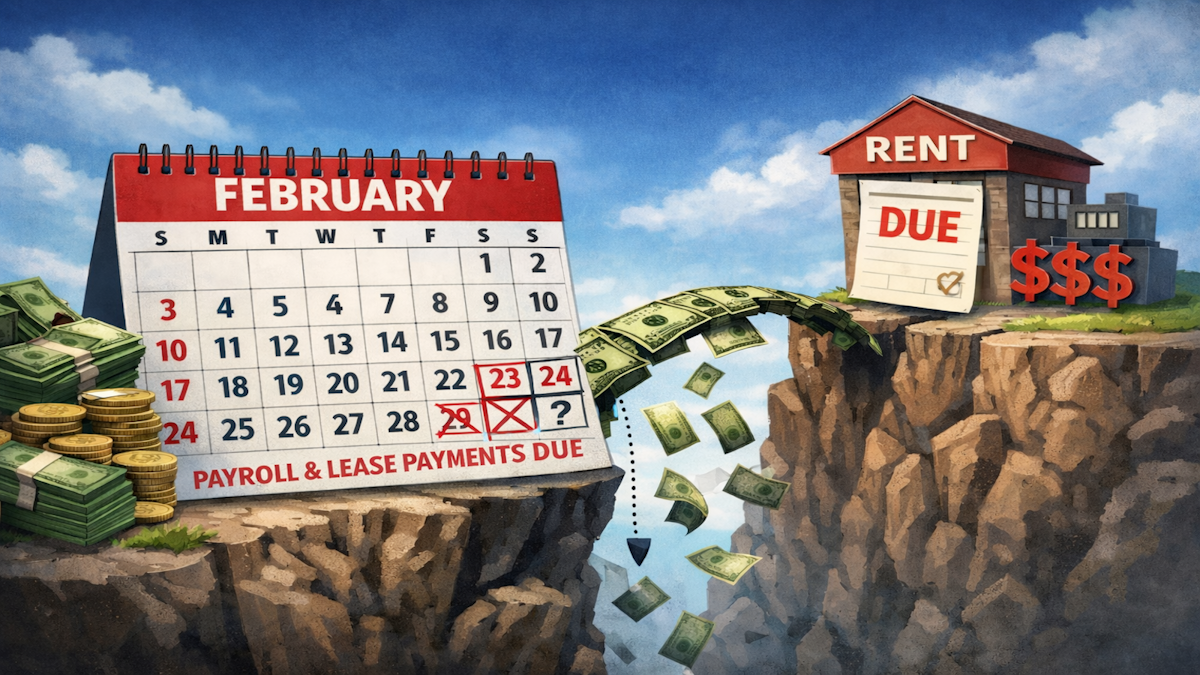
And Q1 is particularly brutal. Post-holiday customer payment slowness collides with year-end bills coming due, tax payments, and insurance renewals. February becomes the perfect storm: low cash reserves from the holiday season, big annual expenses hitting, and receivables still 30-60 days out.
Source: Upflow State of B2B Payments 2024, Atradius Payment Practices 2025
Why "The February Gap"
My mentor in entrepreneurship used to always say "cash is king". Profit is an accounting concept.
That really hit home with my first February cash crunch at ForwardLine. Our business, like many others collected revenue daily, but we paid our bills monthly like most businesses. Rent, payroll, software, insurance: all the same fixed costs hitting on the same schedule every month.
February was always our tightest month. Same bills as January. Same bills as March. But three fewer days of revenue collection. A general lull in business after the new year plus a 10% reduction in revenue days meant we'd end February with notably less cash than we started, despite being profitable every single day. Somehow it was a shock to me the first time I experienced it. In reality, it was predictable, it was mathematical, and it was a pain every single year.
The irony? We were in the business of helping other businesses manage cash flow gaps, and we had our own built into the calendar. It taught me that cash flow timing problems aren't always about mismanagement—sometimes they're just about math and calendars and the fact that February is shorter than every other month.
Why Small Businesses Face This Differently
Large companies have revolving credit lines, treasury departments that forecast cash 12 months out, collections specialists, and the market leverage to demand better payment terms. A Fortune 500 company can operate on Net 90 receivables because they have credit facilities that would fund your entire business three times over.
You're the CFO, the collections department, and the primary revenue generator. Your "credit line" is often a business credit card at 18% APR or, if you're like many of our ForwardLine clients were, a short-term loan at 1.5% per month (18% annualized) just to cover the gap between payables and receivables. And if you push too hard on collections, you risk damaging relationships that represent 20-30% of your revenue.
But here's what those corporate treasury departments can't do: You know your customers personally. You understand their business cycles. You know when they're flush with cash and when they're tight. That proximity—those relationships—can become your most powerful cash flow management tool. It allows conversations about payment timing that corporate purchasing policies would never permit.
What You Can Actually Control
Look, I'm not going to pretend you have time for complex financial modeling. You're running a business. But there are two practical levers that actually move the needle on cash flow timing.
Get Paid Faster
The goal: Shorten the time between doing the work and receiving payment.
Deposits upfront: 25-50% before starting projects over $5K. This isn't unusual—it's standard practice in construction, professional services, and project-based work.
Invoice immediately: Don't wait until the end of the month. Invoice the day you complete the work or hit a milestone. Every day you delay invoicing adds a day to your payment timeline.
Shorter payment terms: Ask for Net 15 instead of accepting Net 30. Many clients will agree simply because you asked. The worst they can say is no—and you're no worse off than before.
Make it easy to pay: Accept credit cards, ACH, digital payments. Friction delays payment. A client who has to write and mail a check will take longer than one who can click "pay now" in an email.
Early payment incentives: Offer 2% discount for payment within 10 days. This costs you less than loan interest or the opportunity cost of delayed cash.
Use your relationships: You know your customers personally. "I've noticed you process payments on the 15th. Would it help if I sent invoices at the start of the month so they align with your schedule?" That conversation is your advantage over big companies with rigid billing systems.
Pay Smarter (Not Later)
The goal: Extend time between receiving bills and paying them without burning vendor relationships.
Know your actual terms: If vendors give you Net 30, pay on day 30, not day 3. You're not being a bad customer by using the terms they offered—you're managing your business.
Ask for better terms: Request Net 30 if you're currently on Net 15. Most vendors will extend terms for good customers. They'd rather give you 15 extra days than lose your business.
Use credit card float strategically: Put predictable monthly expenses (software, subscriptions, insurance) on a business card, then pay it in full each month. You've just created 30 days of timing buffer.
Talk to key vendors: "We're working on cash flow timing. Can we move from Net 15 to Net 30?" They'd rather extend terms than lose a reliable customer. Be honest about what you need.
Don't delay strategically important payments: Your best suppliers, critical services, and employees get paid on time. Everything else can be managed strategically within your terms.
That's it. Not complicated, but requires discipline. And it requires visibility into what's actually coming and going.
The Forecast: Why Visibility Changes Everything
When I took over operations at ForwardLine, I had to unlearn everything I thought I knew about managing a business. I'd been trained on P&L statements—revenue, expenses, profit. But cash doesn't follow the P&L timeline.
We built a 13-week rolling cash flow forecast. I didn't maintain it myself—we had a controller whose job it was to update it daily and share it with me. Twice a week, we'd sit down and review the details together. Where were the gaps? Which receivables were coming in? What large payments were going out? What did Week 7 look like compared to Week 11?
That forecast revealed things the P&L never could—like the fact that we'd be $40K short in Week 7 even though we were profitable, because three large customer payments all came in Week 8. Or that Week 11 looked dire until you realized a quarterly tax payment was skewing the picture. Having that visibility three months out meant we could plan, adjust payment timing, accelerate collections, and avoid surprises.
Most small business owners don't have the luxury of a CFO or a controller. But here's what you do need: a sense of where your cash is coming from and going to over the next three months.
It doesn't have to be daily updates or sophisticated modeling. It can be a simple spreadsheet you update weekly. Four columns for the next four weeks if that's all you can manage. Thirteen weeks if you want the full picture. The critical thing is visibility—knowing that the February crunch is coming when you're still in mid-January and can do something about it.
Why This Matters
Because having that forecast—even a rough one—changes everything else. Once you can see the timing gaps, you know which levers to pull. You know that you need to call that big client about early payment before Week 5, not during Week 5. You know that you can delay that equipment purchase from Week 3 to Week 7 when you'll actually have the cash. You know when to have the vendor conversation, when to push for deposits, when to use the credit card strategically.
Without visibility, you're reacting to cash crunches. With visibility, you're managing timing. That's the difference between constantly scrambling and running a sustainable business.
If You're In The Gap Right Now
Immediate Actions:
1. Call your three biggest outstanding receivables and ask about accelerating payment. Explain you're managing Q1 cash flow and would really appreciate early payment. You'll be surprised how often this works.
2. Review what's due this week vs. next week. What has flexibility? What absolutely must be paid? Be strategic about timing within your terms.
3. Talk to your bank about a line of credit before you need it. Banks are much more helpful when you're not desperate. Having access to a line of credit for timing gaps is different than relying on loans to operate.
4. If you need a short-term loan, be clear about whether this is a one-time timing issue or a recurring pattern. Loans solve temporary gaps—they don't solve structural cash flow problems. If you're borrowing every quarter to cover the same gap, you have a structural issue that needs different solutions.
To Prevent Next Time:
1. Start tracking four weeks of cash flow this week. Even a rough forecast. Update it weekly.
2. Review your payment terms with your five biggest clients. Identify timing mismatches. Have conversations about aligning payment timing.
3. Make payment timing a normal part of customer and vendor conversations. Don't wait until you're in crisis mode. Build it into how you do business.
The Questions That Matter
Before you close this tab:
About Your Inflows:
Do you know the actual average days from invoice to payment for each client? Have you ever asked clients for better payment terms, or do you accept what's offered? What would change if you required 25% upfront on all projects over $10K?
About Your Outflows:
Are you paying vendor bills the day they arrive, or strategically on their due date? Do you know which vendors would extend terms if you asked? Are you using your credit card for timing buffer, or just racking up interest?
About Your Visibility:
Do you know what your cash position will be in four weeks? Could you cover next payroll if your biggest client was 30 days late? Do you look at your P&L more than your actual bank balance?
About Your Knowledge:
Could you describe your cash conversion cycle? Do you know when to expect each receivable and each payable? Have you ever built even a simple cash flow forecast?
The Bottom Line
Cash flow management isn't intuitive, and it's rarely taught. But it's also not complicated. Cash is king because timing matters as much as profit. You don't need to become a CFO or build sophisticated models. You need to know when money is coming and going, manage the levers you actually control, and see problems early enough to solve them.
The goal isn't perfection. It's avoiding the February panic. It's building breathing room. It's making sure that a profitable business doesn't run out of cash because of a timing gap you could have seen coming.
Short-term loans have their place—capturing growth opportunities, bridging unexpected gaps, smoothing out seasonal fluctuations. But the best alternative to needing a loan is managing your cash flow well enough that timing gaps don't become crises. It's having visibility into your numbers, using your customer relationships strategically, and building enough buffer that you can weather the normal ups and downs of business.
That's how you turn cash flow from a constant source of stress into just another part of running your business. Not by becoming a financial expert, but by paying attention to timing and managing the simple levers you actually control.
Enjoyed this article?
These ideas come from Unconvention — Sri Kaza's guide to competing smart as a small business.
Copyright 2026
Sri Kaza