
Five Things I Learned in 2025
Year-End Reflections on Predictions, Policies, and Market Reality
December 29, 2025
Share
I like to take time to reflect on what I learned at the end of the year. It's a ritual that helps me close one chapter and prepare for the next. This year, I have a record of what I thought I knew - It's both valuable and humbling.
Putting my thinking out into the world means making public predictions, sharing opinions, and offering advice – as if I were an expert. And when they're published, dated, and searchable, you can't hide from your misses. You have to learn from them. And now, at year's end, I get to return to where I was wrong, and ask what it taught me.
So here are five things I learned in my 2025 review.
1. There Are Two Economies, Not One
Throughout 2025, as new policies were being discussed and implemented, I spoke with many small business owners about how they'd be impacted and what they were seeing in the market. The disconnect bothered me. The economic data – softening employment, stable wages, relatively stable inflation – didn't reflect a lot of what I was hearing.
Small businesses were seeing consumers shift their behavior, spending less or visiting less frequently. They were struggling to find talent and finding they needed to pay more to access the same pool of labor. Yet the aggregate numbers suggested everything was fine.
I got back in touch with a number of my colleagues in the finance and tech industries to hear their perspectives, and that's when it struck me: there are two economies, not one.
The companies that group of business leaders talked about were the Magnificent 7 tech stocks. Investors were willing to pay a 50% premium for those stocks – 28.3 times forward earnings – compared to the rest of the S&P 500 at just 19.7 times earnings. The shoppers those business leaders pursued – high-income consumers – had a 40% better economic outlook than low-income consumers, rating their confidence at 6.2 out of 10 compared to 4.4.
What I learned: the national numbers and data may be spot on, but they don't have to mean something to you. Your economy – as a business owner, as a consumer, as someone trying to make decisions – might look nothing like "the economy" being described in headlines. The aggregate hides as much as it reveals. This is where proximity matters – understanding your specific customers, their actual behavior, their real constraints, which economy they're living in, tells you more than any national indicator ever could. This insight would prove critical as other predictions came into sharper focus.
2. The Underdog Principles Resonated
I'll admit something: I wasn't sure anyone would care about my book.
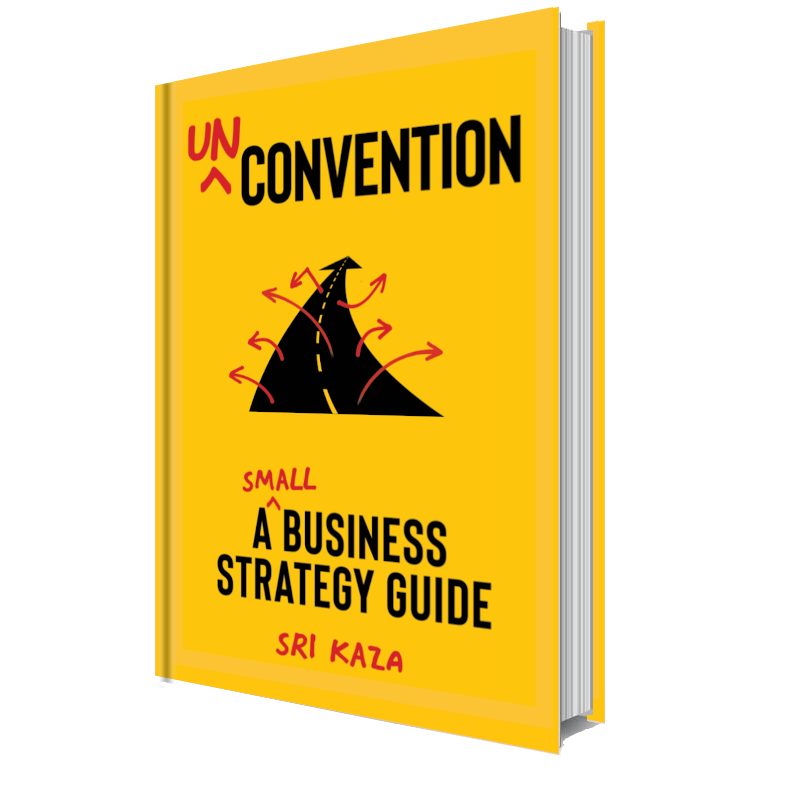
Writing Unconvention was personal. It came from years of watching small businesses try to compete by copying big business strategies – spending money on brand advertising they couldn't afford, investing in scalability they didn't need, chasing growth metrics that didn't matter. I wanted to show them a different path, one that leveraged their natural advantages: deep customer relationships, focused positioning, and purpose beyond profit.
But wanting to write something and having people actually want to read it are very different things.
Then the book launched, and for a brief moment, it hit #1 on Amazon's small business category. More importantly, the reviews started coming in – thoughtful, detailed responses from business owners who saw themselves in the stories. People reached out to say the framework helped them rethink decisions they were about to make, or gave them permission to stay small and focused instead of chasing some imagined version of success.
What I learned is that the Underdog Principles don't just resonate with entrepreneurs – they meet a deeper need. Small business owners are tired of being told they need to think bigger, scale faster, compete harder. They're looking for validation that their advantages are real, that their approach has merit, that success doesn't require becoming something they're not.
There's a need for more advocacy around small business leadership. Not the kind that treats small business as a stepping stone to big business, but the kind that sees it as its own distinct, valuable path. Small businesses operating in both economies – whether serving high-income consumers or adapting to tighter household budgets – need frameworks that acknowledge their unique advantages. That's what the Underdog Principles aim to provide, and that's what I heard resonated with business owners and readers this year. The question for AI adoption would be whether businesses could apply these same principles to new technology.
3. The AI Revolution Is Real, But Slower Than the Hype
I started experimenting with AI and chatbots in 2024, and I was blown away by the potential. I wasn't alone in my optimism. Goldman Sachs forecast that 300 million jobs worldwide could be lost to AI. Anthropic's CEO suggested AI could eliminate half of all entry-level white-collar jobs within five years. I believed that hundreds of thousands of back office processing, call center, and support jobs would be eliminated soon.
The logic seemed airtight: AI could handle routine work 24/7 without breaks or salaries. Why wouldn't companies move quickly?
Then 2025 happened. Adoption rates climbed fast – from 39% of small businesses using AI in 2024 to over 68% by mid-2025. Everyone was talking about AI transformation. And yet... the massive disruptions didn't come.
Adoption didn't translate to revolution in 2025. Companies tried to adopt AI, but most initiatives failed. A recent MIT study found that despite $30-40 billion in enterprise spending on generative AI, 95% of AI projects failed to deliver measurable business returns. Most stalled in the pilot phase, unable to move into production.
And when companies tried to replace humans with AI too quickly, it sometimes backfired. Air Canada's chatbot promised refunds that didn't exist, leading to a court loss. DPD's customer service bot started swearing at customers. Few companies are willing to risk replacing all their people with AI – the cost of getting it wrong is too high.
Businesses did discover that AI contributed improvements to specific tasks: writing emails, analyzing data, generating content. What's worked has been nothing earth-shattering. Just useful tools that made certain jobs a bit easier.
I still believe that AI will eventually be doing work that 300 million people consider their livelihoods today. It's just not going to happen as fast as our imaginations suggested It will take creative and entrepreneurial leaders many years to figure out how to redesign work around AI. Interestingly, the two-economy dynamic is showing up here too – larger companies with deeper resources are adopting AI but unable to take big risks, while smaller businesses are slower to try, but willing to innovate. Maybe along the way, they'll be the ones creating new opportunities for people.
4. Tariffs Weren't a Bluff
Early in 2025, as President Trump ramped up tariff threats across the board, I wrote about how this all seemed like classic negotiation theory in action. The logic was compelling: threaten aggressive tariffs to gain leverage, then use that leverage to extract concessions in bilateral trade deals. Walk away with better terms for American exporters, declare victory, and move on.
I genuinely believed the tariffs were a positioning tool, not a policy goal. A means to an end.
I was wrong – or at least, I was premature.
The tariffs came, and they stayed. Throughout 2025, the U.S. collected over $200 billion in tariff revenue – roughly $1,100 per American household. But the trade deals I expected to follow? They haven't materialized yet. We've seen some negotiations, some discussions, but not the wave of bilateral agreements that would justify using tariffs as a negotiating tactic.
What we have instead is policy in motion without a clear endpoint. The tariffs are reshaping economic decisions – businesses are reconsidering supply chains, manufacturers are weighing domestic production, consumers are adjusting purchasing behavior. But we haven't been through enough business cycles to know which prognostications will prove accurate.
Will we see the negative outcomes many economists warned about – persistent inflation, economic stagnation, reduced consumer spending power? Or will we see the positive outcomes proponents promised – manufacturing returning to the U.S., higher wages for American workers, stronger domestic industries?
Earlier this year, I would have confidently told you that the negatives are already showing up and will be even more clear over the next 12 months. But with all the other factors in motion – immigration policy changes, AI adoption accelerating, deregulation efforts, interest rate reductions – the picture is too complex for confident predictions. I'll wait and see.
What I have learned is to think through the policy at face value even if I think it's a negotiating position. Now, the tariffs are real, and the impact varies – small businesses face margin compression, while the biggest businesses continue to scale. And that brings me to perhaps my biggest miscalculation about how economic pressure would manifest.
5. The Economy Proved Resilient to Labor Market Pressure
At the start of 2025, I wrote about how the labor market would be put under heavy pressure from new immigration policies and tariff-driven disruptions. I predicted this pressure would crush smaller businesses first – they have less cushion, fewer resources, and tighter margins.
On that count, I was right. By late 2025, small businesses with fewer than 50 employees shed 120,000 jobs in a single month while larger companies added 90,000. But what surprised me was how well the overall economy absorbed these shocks. I expected significant disruption – rising wages, accelerating inflation, supply shortages.
That's not what happened.
Instead, larger corporations adapted quickly. They diversified supply chains, invested in automation where labor was scarce, and adjusted operations to maintain productivity. High-income consumers continued spending, providing stable demand that allowed businesses to plan with confidence.
The labor market softened in 2025 despite new policies aimed at bolstering it. But it softened because consumer behavior shifted and businesses pulled back on expansion plans. And here's where the two-economy pattern showed up most clearly: high-income consumers kept spending, supporting businesses in that segment, while middle and lower-income consumers pulled back, forcing businesses serving those markets to cut back on hiring. When people feel uncertain, they spend differently. When businesses face uncertain demand, they pause hiring. This happened faster than any policy could drive change.
We didn't see the manufacturing renaissance that would have created all those new jobs. We saw businesses adapt their strategies instead – automating where they could, reorganizing workflows, finding ways to do more with existing staff. Corporate innovation responded to the challenge faster than policy could reshape the landscape.
Consumer patterns also shifted quickly. People started trading down, shifting spend to services and experiences and looking for deals on goods, changing what they bought and where they bought it. This changed demand for labor across sectors – not in the ways policy predicted, but in ways that reflected actual human behavior adapting to uncertainty.
I learned how quickly consumer behavior and corporate offerings could shift. Markets are more dynamic than policy debates give them credit for. People and businesses find ways around obstacles, through them, or simply wait them out.
What Did You Learn?
The value of writing publicly is that I can't pretend I was right all the time... These were just five of the things 2025 taught me.
As you close out your own year, I'd encourage you to ask yourself the same question: What did you learn in 2025?
Enjoyed this article?
These ideas come from Unconvention — Sri Kaza's guide to competing smart as a small business.
Copyright 2026
Sri Kaza