
War and the Small Business Economy
The oil shock is here. The food shock is coming. And Main Street has no cushion left.
April 21, 2026
Share
Six weeks into a war, two weeks into a ceasefire, and things are starting to look up. The ceasefire has held so far, a deal may be close, and starting today businesses can apply to reclaim tariffs the Supreme Court ruled unconstitutional -- up to $127 billion owed back to American importers. Markets have welcomed all of it. Stocks have recovered their war-related losses and kept climbing.
But oil is still above $100 a barrel. Diesel is still at $5 nationally. Energy Secretary Chris Wright said Sunday that gas prices may not fall below $3 a gallon until 2027. The energy shock from six weeks of a closed Strait of Hormuz doesn't unwind the day a ceasefire holds. Analysts are warning the economic damage could linger for six to twelve months after the fighting stops entirely.
Large companies can absorb that kind of timeline. They hedge fuel costs, carry reserves, and have the contracts and capital to wait it out. The stock market is telling you how they feel. It is not telling you how John Andrews feels.
Ask John Andrews How the Rally Feels
John Andrews drives more than 100 miles every week through South Carolina delivering fresh home-cooked meals to his clients, most of them elderly, most of them on fixed incomes. His costs moved in two directions at once almost immediately: food prices climbed, and the gas to deliver it got more expensive overnight.
"The economy is killing me on food prices. And gas prices are tough now, too," Andrews told CNN earlier this month. "It's kind of a double whammy. I'm working just as hard as ever, but I'm losing ground here."
He hasn't raised prices yet. He knows his customers can't absorb another increase. "My clientele is more elderly than not, and I can't just keep hitting them with price increase after price increase," he said. "But now I'm simply not making any money."
He could raise prices. The math would justify it. Instead, he's choosing to protect the people he built his business to serve, absorbing the loss himself. That's not naivety. That's a small business owner holding to the reason he started in the first place.
Andrews is not alone. Across the country, small businesses are absorbing an economic shock that started at the Strait of Hormuz and is working its way into every corner of the economy.
How a Narrow Channel Became America's Economic Problem
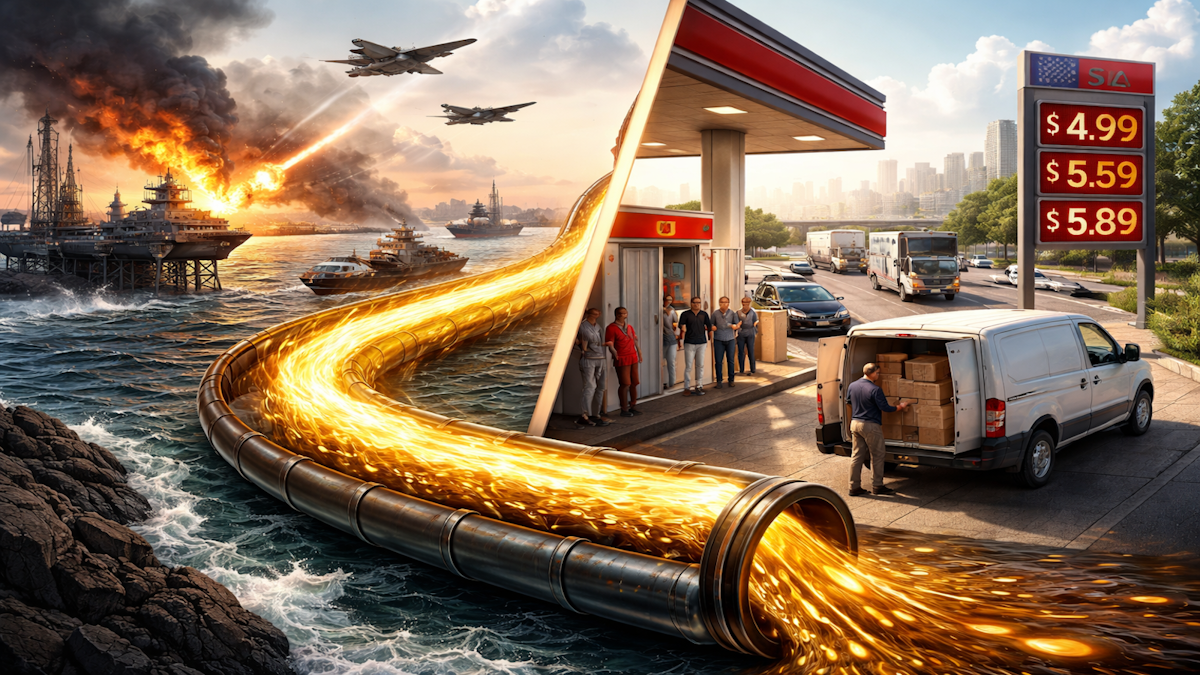
The Strait of Hormuz is 21 miles wide at its narrowest point. When Iran effectively closed it in late February, the effects were immediate. Within two weeks, Brent crude surged more than 40 percent. The national average for gasoline passed $3.79 a gallon. Diesel, which powers most of the trucks moving goods across the country, topped $5 nationally and climbed higher in some regions.
Brent Crude spot price. Source: Federal Reserve Bank of St. Louis / U.S. Energy Information Administration
Oil price shocks are different from tariff shocks. Tariffs took months to filter into consumer prices. Oil is immediate. The moment crude spikes, fuel surcharges go up, shipping rates go up, and grocery margins go down. "An immediate spike in gasoline prices strains household budgets and also raises the cost of shipping, airline tickets, and products that rely on oil-based inputs," said Stephen Kates, a financial analyst at Bankrate, when the war started. That was when gas was at $3.40.
Small Businesses Have No Cushion Left
Large corporations are not immune to energy shocks, but they have tools small businesses don't. Big trucking companies like JB Hunt and Schneider National negotiate fuel surcharges into their contracts, carry working capital reserves, and hedge against price swings. Small operators run on spot market rates, pay for fuel upfront, and often wait months to get paid for completed hauls.
Jamie Hagen owns Hell Bent Xpress, a small fleet operation in South Dakota. Since the war started, diesel costs have jumped 41 percent. "Cash flow is becoming our biggest issue," he told CNN. He is considering parking his rigs. "Small guys in the spot market are really getting dumped on right now," said Dean Croke, principal analyst at DAT Freight and Analytics.
This asymmetry matters beyond trucking. Every time a small trucking company raises rates or parks a truck, the businesses depending on it feel it in delivery costs, in lead times, in the reliability of their supply chains. Large retailers can route around disruptions. A restaurant owner or a specialty retailer often cannot.
And these businesses were already stretched thin. After years of tariff-driven cost increases and softer consumer spending, most small businesses had little room to absorb another shock. "Because many businesses are already absorbing most of the cost of tariffs enacted by the administration over the last year, they have little wiggle room," said Boston College economics professor Brian Bethune.
The Damage Won't Stop When the War Does
The most important thing to understand about this particular shock is that its economic consequences won't resolve at the same speed they escalated.
Even if the Strait of Hormuz reopened tomorrow, oil analysts and energy executives have warned that prices would remain elevated for months as countries around the world restock depleted reserves and rebuild damaged infrastructure. Qatar's largest LNG facility sustained missile damage that could take years to fully repair. The strategic reserves governments released in March were a bridge, not a solution.
The longer-term consequences are already being priced in through the food supply chain. About a third of the world's fertilizer passes through the Strait of Hormuz. That fertilizer is needed now, for spring planting. Randy Rhoads co-owns Rhoads Brothers Farm in Pennsylvania. Five weeks into the conflict, he was already paying 25 percent more for a truckload of fertilizer.
We have to absorb it. There is nowhere to pass it onto.
- Randy Rhoads
Co-owner, Rhoads Brothers Farm
Those higher input costs don't show up as higher food prices immediately. They show up at harvest, in the fall. The grocery shock economists have been warning about may not fully arrive until the second half of 2026.
Meanwhile, the Federal Reserve is caught in a bind it can't easily escape. Higher energy prices push inflation up, which argues against cutting rates. Slower growth argues for cutting them. The result is paralysis, and what that means for small businesses is that borrowing costs stay high during exactly the period when cash flow is most compressed. Mark Zandi, chief economist at Moody's, put the underlying dynamic plainly: "Higher gasoline prices act like a regressive tax, as lower-income households devote a higher share of their budget to energy." For small businesses that serve everyday consumers rather than high-income ones, that regressive tax lands directly on their revenue.
One practical note before we close: if your business paid IEEPA tariffs on imports before the Supreme Court struck them down, the refund portal opened today. The government estimates it owes $127 billion to importers. The process runs through CBP's ACE portal at cbp.gov. Refunds take 60 to 90 days after approval, the burden of filing falls on you, and the paperwork has to be clean. It won't solve a cash flow crisis this week. But if the money is owed to you, it's worth the hour to claim it.
The Businesses That Survive Are the Ones That Mean Something
John Andrews is losing money right now because he refuses to raise prices on people who can't afford it. That is a hard place to be. It is also exactly the kind of business that communities show up for when things get dark enough.
We saw it during COVID. The restaurants, the local shops, the service businesses that had spent years genuinely embedded in their communities, making decisions that put neighbors first, found that those neighbors came back for them. Crowdfunding campaigns, loyalty from regulars who could have gone elsewhere, customers who drove past a chain to keep a Main Street business alive. None of that was guaranteed. But it wasn't random either. It went to the businesses that had earned it.
The economic consequences of this conflict will be longer and harder than the news cycle is suggesting. Small business owners running on thin margins and thinner reserves are right to be worried. But the ones most likely to come through are the ones, like Andrews, who are still doing the work they set out to do, even when the numbers say they shouldn't have to.
That's not just grit. That's the foundation of a business worth saving.
Enjoyed this article?
These ideas come from Unconvention — Sri Kaza's guide to competing smart as a small business.
Copyright 2026
Sri Kaza