
The Workforce Pipeline Doesn't Work
Good employers can't find good people. New data shows why.
March 16, 2026
Share
Last week, a bipartisan commission released one of the more quietly alarming reports to come out of Washington in years. The Bipartisan Policy Center, after more than a year of work by a 24-member panel that included former governors from both parties, published "A Nation at Risk to a Nation at Work." The title alone tells you something. These aren't activists or think tanks with an agenda. They're pragmatists who looked at the numbers and concluded: we have a serious problem.
The numbers are worth sitting with. Half of college graduates from the last decade were underemployed a year after graduation. Nearly three-quarters were still underemployed a decade later. Some 37.6 million American adults under 65 have college credits and no credential to show for it. And the laws that govern how Americans access job training were last updated in 2008 and 2014, before generative AI existed, before the gig economy matured, before remote work became standard.
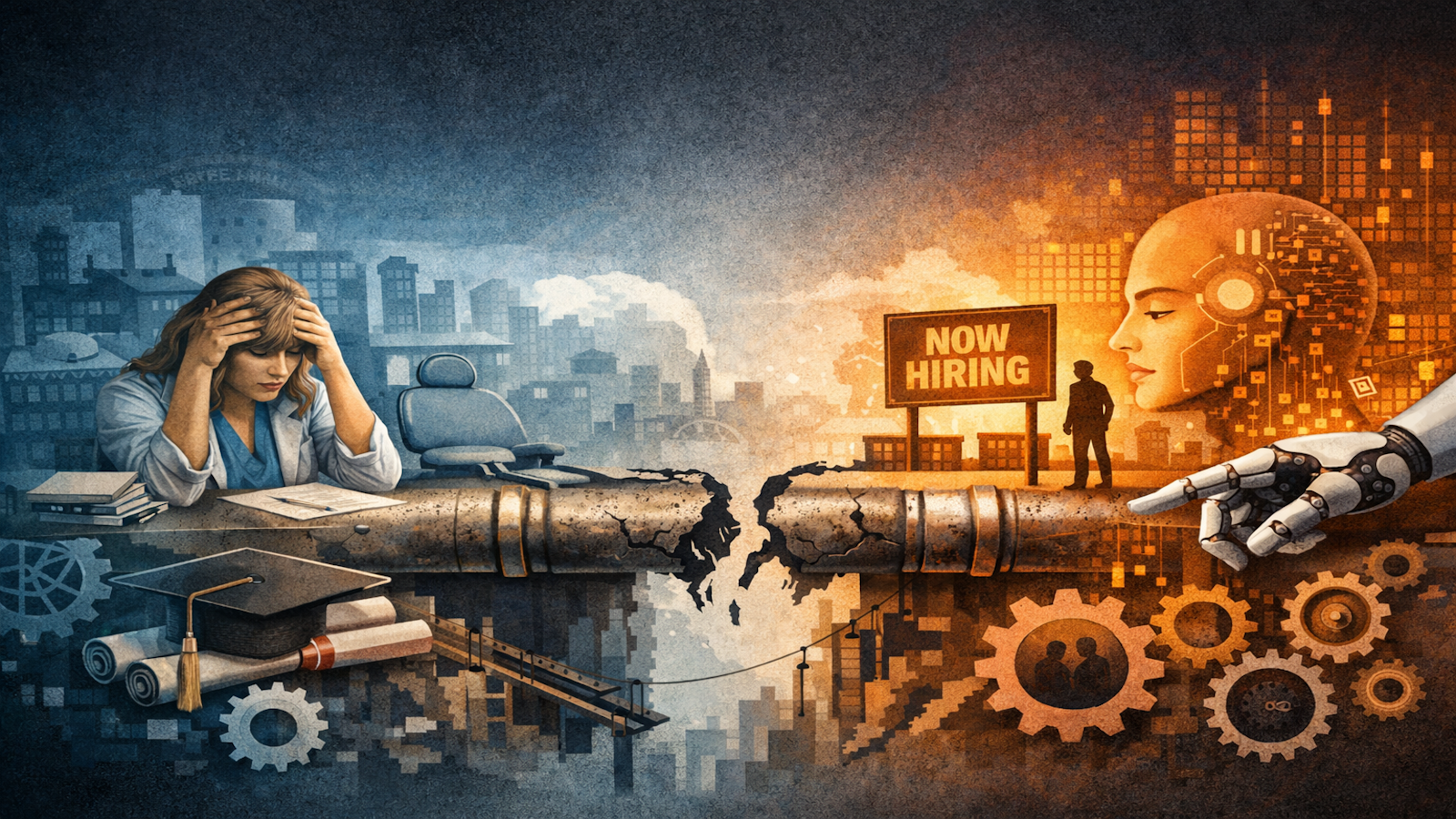
A dentist I know named Shelley has been trying to hire a scheduling assistant for her practice for the better part of three months. She posted the role, read through hundreds of applications herself, and reached out to the ones who looked like a good fit. Most didn't respond at all. The few who scheduled interviews ghosted before they showed up. She pays fairly. Her staff turnover is low, which means the people who work for her generally want to keep working for her. She's doing everything right. And she still can't find someone to answer her phones.
Shelley isn't alone, and her situation isn't bad luck.
The Gap Was Growing Long Before Anyone Noticed
The BPC report describes a workforce system "not fully aligned with the demands of an AI-driven economy," with a growing skills mismatch leaving employers unable to find qualified workers even as unemployment fluctuates. That framing is polite. What it means in plain terms is that the training pipeline has been quietly failing for years, and businesses are now paying the price.
NFIB data has shown for several consecutive years that quality of labor is the top concern among small business owners, ahead of taxes, ahead of inflation, ahead of regulation. This isn't about wages. Business owners who raise pay are still struggling to find people who show up, stay, and can do the job. The problem isn't compensation. It's preparation.
Bipartisan Policy Center, A Nation at Risk to a Nation at Work, 2026
The credential gap is part of it. Thirty-seven million adults with partial college and nothing to show for it represents a massive pool of capable people who fell out of a system that wasn't designed to catch them. They're not unqualified. They're undercredentialed, which isn't the same thing. But most hiring processes can't tell the difference.
AI Is Accelerating the Gap, Not Filling It
The BPC commission found that 57% of current U.S. work hours could be automated with technology that already exists. That figure is nearly double McKinsey's projection from just two years prior. The pace matters as much as the number.
Previous waves of automation tended to eliminate the most routine tasks while creating new roles that required more judgment and skill. That pattern may be repeating, but this time the speed is different. The entry-level, routine jobs that historically served as on-ramps for undertrained workers are disappearing faster than new roles are being created. And the jobs that remain increasingly require skills that the existing training system wasn't built to develop.
Brookings Institution, Automation and the American Worker, 2019; updated analysis
Workers without a bachelor's degree hold roughly half of their job tasks automatable with existing technology. Those with a degree face 29%. That gap isn't just a wage story. It's an on-ramp story. The jobs that have historically absorbed people still finding their footing are the ones disappearing first. The remaining jobs require more preparation than the training system currently provides.
This creates a specific trap for small businesses. Large companies can hire junior people and invest in developing them. They have onboarding programs, L&D departments, and training budgets. Many of them are also eliminating junior roles and apprenticeship paths in favor of AI tools, which compounds the problem downstream. Fewer people are getting the foundational experience they need to become the mid-level workers every employer is competing to hire.
A small business owner doesn't hire for a pipeline. They hire because someone left or because they're growing and need help now. There's no buffer, no cohort, no backup plan. When Shelley's new scheduling assistant ghosts two hours before their first shift, she's the one answering the phones.
This Isn't a Market Problem. It's a System Problem.
The BPC report calls for a national Talent Advisory Council to coordinate the 150-plus federal programs that currently spend over $230 billion annually on workforce development with no coherent strategy. Former Massachusetts Governor Deval Patrick described it plainly: the system is fragmented, hard to access, and only useful if you already know where to look.
That fix, even if it happens, will take years. Congress hasn't updated the relevant laws since before most people had heard of ChatGPT. There is no version of this story where Washington solves Shelley's hiring problem in 2026.
The structural breakdown is real. The policy response will be slow. Small businesses are bearing the cost in the meantime.
Stop Hiring for Today. Start Building for Tomorrow.
None of this means small business owners should give up on hiring. It means they need to reframe what hiring is for.
The businesses that will come out of this labor market stronger are the ones that stopped treating hiring as a transaction and started treating it as development. That's a different mindset, and it changes nearly every decision that follows.
On the pipeline side: community colleges and trade programs are actively looking for employer partners who will offer real work experience to students before they graduate. Most small business owners have never had that conversation. It's worth having. A scheduling assistant who trains alongside your team for a semester before being hired full-time is a fundamentally different candidate than one who responds to an Indeed post. You know who they are. They know how your practice works. The ghosting problem largely disappears.
Apprenticeship doesn't have to be formal or complicated. It can be as simple as offering a part-time role to a local college student in a relevant program, with a clear understanding that it's a mutual audition. You learn if they can do the work. They learn if they want to. That's more useful information than a resume and a 30-minute interview.
On the development side: the best retention strategy available to a small business owner is giving people a visible path forward. Not a title change in three years if things go well. A real answer to the question every good employee is quietly asking: if I stay, what do I become?
Large employers are, ironically, becoming worse at this. As AI handles more junior-level work, the apprenticeship model that used to develop talent is eroding at exactly the firms that once did it best. Small businesses can fill that vacuum. The dentist who teaches her scheduling assistant how to read a P&L and manage vendor relationships is developing someone who can eventually run the front of the practice. That person doesn't leave for a $2 raise somewhere else.
The BPC commission is right that a national strategy is needed. But national strategies are built by committees and implemented over decades. Your hiring problem is happening now.
Washington will eventually catch up. The small businesses that stop waiting and start building their own pipelines will have built something that no federal grant can replicate.
Enjoyed this article?
These ideas come from Unconvention — Sri Kaza's guide to competing smart as a small business.
Copyright 2026
Sri Kaza