
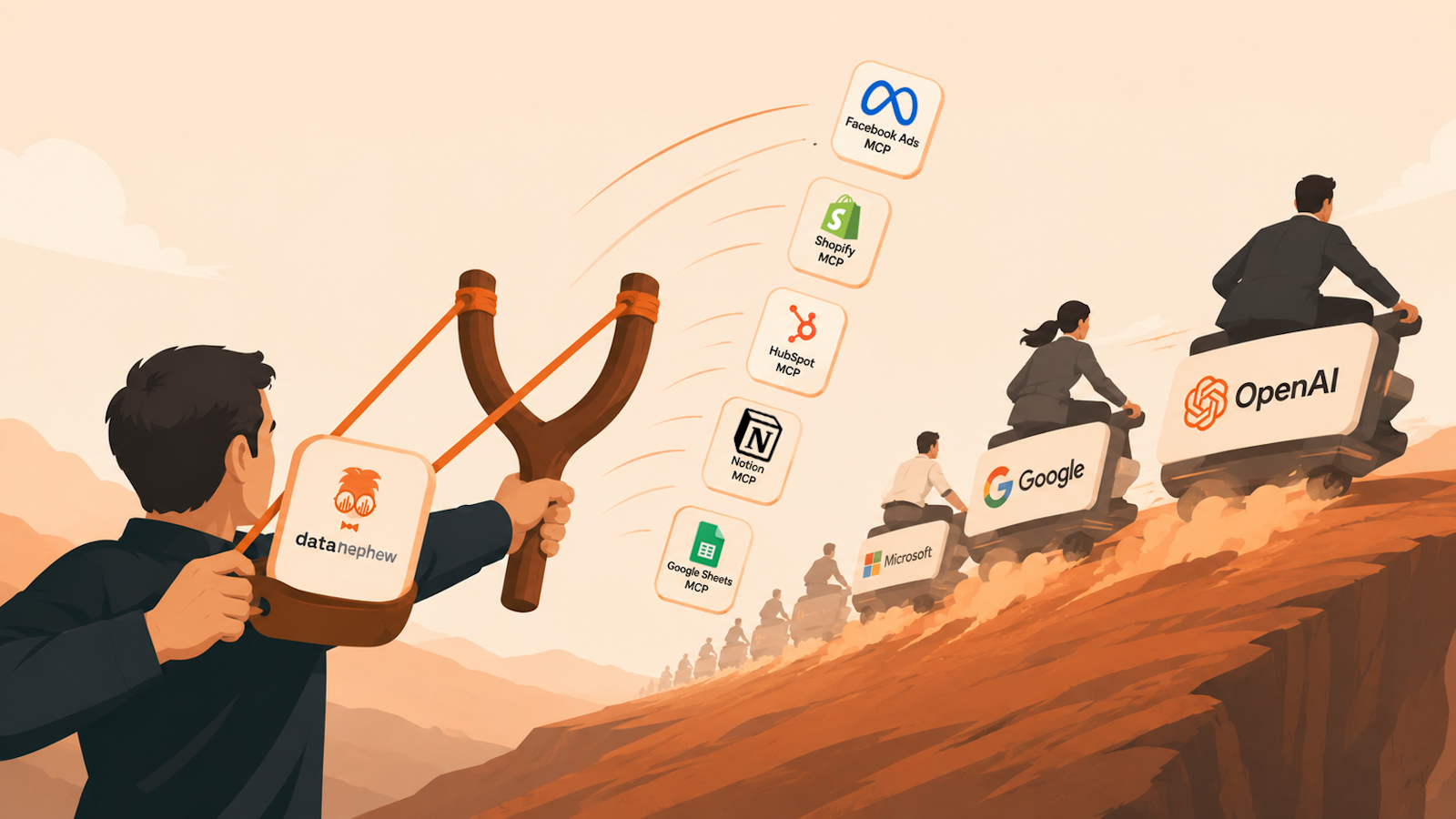
Bring a Slingshot to the AI Arms Race
The connectors that help small businesses fight back and win.
September 15, 2026
Share
Kara had been running her IV nutrient therapy practice for over a decade. Full schedule, loyal regulars, the kind of word-of-mouth reputation that takes years to build. So when new client bookings started thinning out earlier this year, she had an explanation ready before I even asked: the economy. People were tightening up, cutting the extras, and an out-of-pocket wellness service was an easy thing to skip for a few months.
It's a reasonable story. It's also, as it turned out, only part of the real one.
I asked her a simple question: when new clients do book, what do they say brought them in? Most of them said the same thing. They found her on Google.
"So how's your Google performance?" I asked.
She didn't know. She'd never looked. And when I asked why, she said something that stuck with me: "That's for businesses that can afford to play that game."
The Belief That Keeps Small Businesses Out of the Fight
That sentence is the real story here, more than the ranking data underneath it. She wasn't avoiding her data because she didn't care. She was avoiding it because somewhere along the way, she'd absorbed the idea that understanding search rankings, running ad campaigns, and reading analytics were tools built for people with marketing departments. Not for someone running a business by herself.
We set up her Search Console together and pulled up two years of data next to her Google Analytics. In 2024, she ranked in the top 5 for the exact terms her ideal clients search when they're looking for someone like her. By this year, she'd slipped to position 9. A quick search from my laptop showed why: three paid ads for med spas had climbed above her, bundling IV therapy alongside Botox, facials, and a menu of other services, offering a lot less of the personal touch she was known for, but a lot more ad budget behind them.
She looked at their offerings and knew, immediately, that she'd win that comparison for her ideal client. Better fit, better experience, better results. But only if that client actually saw her.
Bigger competitors weren't beating her on quality. They were outspending her on visibility, in a fight she didn't know she was already in.
Everyone Is Already in the Arms Race. Some Businesses Just Don't Know It Yet.
Here's the pattern I keep seeing when I talk with small business owners: people who built something excellent, who know their craft cold, who go completely blank in front of a search ranking report because nobody ever told them this was something they were allowed to compete on.
Meanwhile, the businesses outranking them aren't smarter or more sophisticated. They're just willing to spend, because they've been told, correctly, that spending on visibility works. It's an arms race, and for years it required a budget to even enter.
That's changed. And the strange part is, small business owners are often already holding the new weapon without realizing it.
You're Already Talking to AI. Its Time to Supercharge it.
If you're one of the many small business owners who've started using ChatGPT or Claude to draft emails, think through a pricing decision, or brainstorm marketing ideas, you already have the core tool in place. What most owners don't know is that the same AI assistant can connect directly to your business data through something called a connector, and just answer questions about your actual performance in plain English.
Instead of learning Search Console's Performance tab, applying filters, exporting a spreadsheet, and trying to interpret it, you can ask the AI you already talk to every day: "Which search terms am I losing ground on?" or "Did my rankings drop after March?" That's it. No new tool to learn. Just a new question you can finally ask the one you already use.
First: What Your Vendors Are Already Giving You for Free
Before hunting for new AI tools, start with the software you already use every day. Some of the platforms that run your business now offer connectors or official integrations that let ChatGPT or Claude work directly with your live data. In most cases they're free, take only a few minutes to enable, and immediately make your AI dramatically more useful.
- Notion: Connect your workspace to ChatGPT or Claude so your AI can search notes, projects, documents, and company knowledge.
- HubSpot CRM: Ask questions about contacts, deals, pipelines, and customer activity using your live CRM data.
- Google Workspace: Google is rolling out official MCP support across Workspace and Cloud services, making Docs, Drive, Gmail, Calendar, Maps and more available to AI assistants.
- Canva: Create, edit, search and export designs directly from ChatGPT, Claude and other MCP-compatible assistants.
- Meta Ads: Meta's new AI Connector lets Claude and ChatGPT analyze campaigns, create ads, adjust budgets, and manage audiences directly from your ad account.
One thing to keep in mind: every platform has incentives. Google and Meta want your advertising dollars. Shopify wants you selling through Shopify. Their AI recommendations can be incredibly helpful—but remember they're optimizing for your success and for their business model. Use their data. Keep your judgment.
Second: The Connectors Built Just to Help You See Clearly
Beyond what your vendors offer, there's a second category of connector with no stake in how you spend, only in helping you understand your own numbers. This is your actual slingshot: free or low-cost tools built specifically to make search and traffic data understandable, without requiring an agency or a marketing degree.
- datanephew: Always free, built specifically to bring data like your web traffic, page views or reviews into an AI chat
- Windsor.ai: Free tier available, broader cross-channel blending if you're running campaigns across multiple platforms
- Porter Metrics: Paid subscription, strong if you want to combine Search Console, GA4, ads, and Shopify in one place
- Supermetrics: Paid, the most enterprise-grade of the group, 170+ data sources if your needs grow past a single storefront
None of these require you to become an analyst. Pick the one that matches how complicated your online presence already is, and start there.
Picking Up the Slingshot
For Kara, arming herself didn't require a dramatic overhaul. It was one afternoon of finally looking, followed by a short list of fixable things: an outdated page title, a few pieces of content that needed refreshing, a listing that hadn't been touched in a year. Small, unglamorous fixes. But fixes she couldn't have made when the fight was invisible to her.
This week, ask the AI assistant you already use one plain question about your own search or traffic data. You don't need a marketing budget to enter this fight. You need to stop believing it's someone else's fight to have.
Enjoyed this article?
These ideas come from Unconvention — Sri Kaza's guide to competing smart as a small business.
Copyright 2026
Sri Kaza