
Amazon Built an Empire Being Good to Customers. Then It Won.
Dominance changes incentives. The fees tell the story.
May 13, 2026
Share
Nicholas Parks had been selling Valentina hot sauce on Amazon for more than a decade. He knew his customers, knew his margins, and knew the platform well enough to build a real business around it. Then Amazon started selling Valentina too. Amazon placed itself at the top of search results, priced below what Parks could match using the same logistics infrastructure he was paying Amazon to access, and effectively closed him out of the product he'd spent years building.
"It doesn't even matter if I've sold it for 10 or 15 years," Parks told NPR. "Once Amazon starts selling it, I'm just closed out of the market for that product."
He now has seven or eight pallets of Valentina sitting in a warehouse in Alabama with nowhere to go.
Parks isn't an edge case. Douglas Mrdeza built Top Shelf Brands, a Michigan company that sold hair and beauty products on Amazon, into a real operation. When Amazon identified his best-selling products and launched its own versions, the business started to unravel. Top Shelf Brands filed for bankruptcy in 2022. "There was just a lot of moving pieces," Mrdeza said. "They all kind of stemmed back to the way Amazon is both the marketplace and a competitor."
That combination -- marketplace and competitor -- is the structural problem. And understanding how Amazon got there requires going back to what the company used to be.
The Company That Meant It
In the early years, Jeff Bezos ran Amazon on a genuine conviction: customers deserved low prices, vast selection, and relentless efficiency, and any competitor that got comfortable on margin was creating an opportunity. His phrase for it became famous in business circles: "Your margin is my opportunity."
It wasn't just a slogan. It was a business model. Amazon built what it called the flywheel: low prices attracted customers, more customers attracted third-party sellers, seller fees and volume funded lower prices and faster delivery, which attracted more customers. Each part reinforced the next. For a long time, the flywheel created real value for everyone in it, including the small businesses that gained access to a customer base they could never have reached on their own.
The early marketplace genuinely helped independent sellers. A small business making artisanal candles or specialized hardware or niche sporting goods could list on Amazon and reach millions of buyers overnight. The fees were modest. The exposure was enormous. For many small businesses, Amazon was the growth engine that made them viable.
That is not the company Parks and Mrdeza were dealing with.
What Changes When You've Already Won
There is a well-understood pattern in business strategy: the behavior that builds a dominant position and the behavior that exploits one look nothing alike.
While Amazon was fighting for market share, it needed sellers. It needed competitive pricing. It needed the flywheel to keep spinning because it hadn't yet won. The moment a company controls access to the customer so completely that competitors can't credibly threaten it, the pressure that forced good behavior disappears. There is no longer a reason to keep fees thin. There is no longer a need to earn the seller's business every year. The platform becomes something closer to infrastructure -- and infrastructure charges tolls.
Amazon reached that position gradually, then suddenly. By 2022, it controlled more than half of all U.S. online retail sales. Its Prime membership had locked in over 200 million subscribers worldwide. Third-party sellers accounted for 62% of units sold on the platform -- not because Amazon recruited them so aggressively, but because sellers had no comparable alternative for reaching that customer base.
At that point, "your margin is my opportunity" had a different meaning. The margin Amazon was finding was no longer its competitors'. It was its own sellers'.
The Math Changed. The Sellers Felt It First.
The Institute for Local Self-Reliance tracked Amazon's extraction rate from third-party sellers over nearly a decade. The chart below tells the story more plainly than any legal filing.
Institute for Local Self-Reliance / The American Prospect, 2023; Marketplace Pulse, 2022
In 2014, Amazon took 19 cents of every dollar sellers made on the platform. By 2017 it was 27 cents. By 2020, 35 cents. By 2022, the figure had reached 45 cents -- and Marketplace Pulse, analyzing actual seller profit and loss statements, found that Amazon's average cut had crossed 50% of seller revenue for the first time.
The pattern should look familiar. In the Ticketmaster case, independent venues paid whatever fees the system demanded because the alternative was losing access to the concerts their customers wanted. There was no real negotiation -- only compliance or irrelevance. Amazon's marketplace works the same way. When the platform controls access to the customer, the fee is whatever the platform decides it is. Mrdeza watched Amazon identify his best products and launch its own versions. Parks has seven pallets of hot sauce sitting in a warehouse. When you're the only show in town, the fees reflect it.
The pressure came to a head in April 2026, when hundreds of Amazon's largest sellers staged a coordinated advertising boycott, pulling ad spend in a rare show of collective resistance. Eugene Khayman, co-founder of MDS, one of the organizers, put the frustration plainly: "This is no longer just about irritation. It is about cash extraction." One seller told CNBC what the latest policy changes felt like: "This is your business -- subject to my reign."
When the Mission Statement Reversed
In April 2026, California unsealed internal communications as part of its ongoing antitrust case against Amazon. The evidence was detailed.
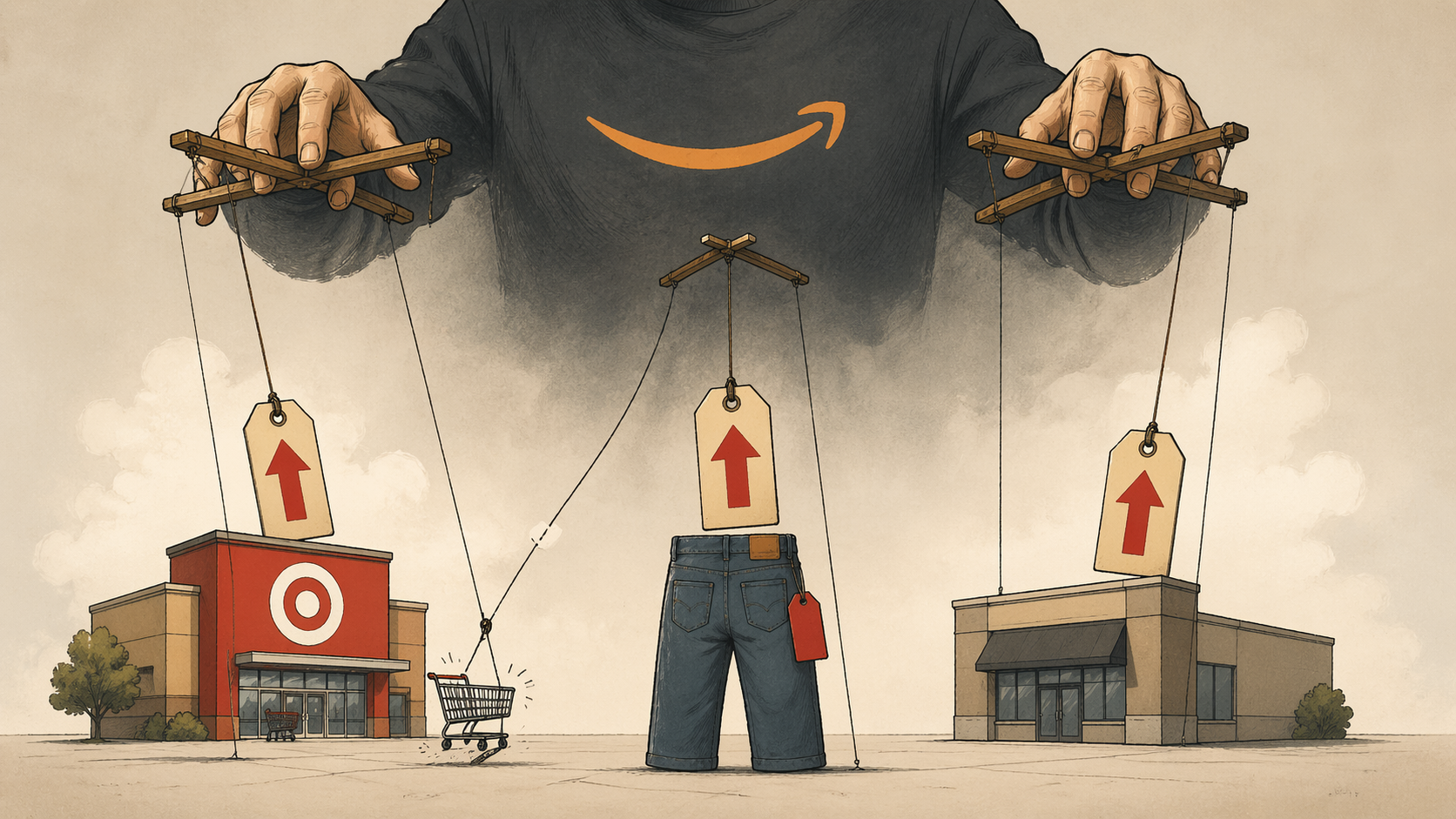
According to the state, Amazon allegedly pressured major brands to ensure that competitors couldn't undercut Amazon's prices. Levi Strauss was allegedly pushed to contact Walmart and raise the price of its Easy Khaki Classic pants from $25.47 to $29.99 after Amazon expressed concern about the lower price. Amazon allegedly pushed Allergan to get Walmart to raise prices on eye drops. Similar coordination was described involving Canine Naturals pet treats and Chewy. California Attorney General Rob Bonta described it as price-fixing "so explicitly and egregiously in writing."
This is the full inversion of "your margin is my opportunity." The early Bezos was hunting for competitors who had gotten fat and complacent on margin. The conduct described in the California filings is a company allegedly working to make sure nobody could be cheaper than it, anywhere. The company that built its empire by forcing prices down was now, according to the state, allegedly working to keep them up.
The trial is not until January 2027. The evidence is already on the record.
The Businesses That Found the Answer Early
Independent bookstores have their own version of the Parks and Mrdeza story, except it happened earlier and some of them figured out what to do about it.
When Amazon launched in 1995 as the "Earth's largest bookstore," independent booksellers were already under pressure from chains like Borders and Barnes & Noble. Amazon made it worse. Between 1995 and 2000, the number of independent bookstores in the U.S. fell 43%. By 2009, the number had hit an all-time low. Experts predicted the industry would not survive.
It did survive. And the way it survived is instructive.
Ryan Raffaelli, a professor at Harvard Business School who has spent years studying industries that beat the odds, documented the independent bookstore recovery in research that has become something of a case study in strategic reinvention. His finding was simple: the bookstores that survived stopped competing on price and selection -- the two things Amazon would always win -- and rebuilt around three things Amazon couldn't replicate: community, curation, and convening.
Community meant becoming a genuine anchor of local life, not just a place to buy things. Curation meant using the knowledge and taste of real booksellers to surface books customers didn't know they wanted. Convening meant turning the store into a gathering place -- author events, reading groups, children's programming -- that gave people a reason to show up that had nothing to do with price.
One bookseller in Raffaelli's research put the strategic insight plainly: "If we see our products as books and what we compete on is price, we lose. If we see our product as an experience, of which books are one piece, then we can compete."
That reframe didn't save every bookstore. Margins remained thin. Rents rose as the stores reinvigorated their neighborhoods. But the stores that survived and grew did so by becoming something Amazon is structurally incapable of being: a specific place, run by specific people, who know their specific community.
What Small Businesses Should Do With This
The California trial is scheduled for January 2027. The FTC's parallel antitrust case is on a similar timeline. Amazon has the resources to outlast regulatory processes, a demonstrated ability to lobby effectively, and a track record of settling on terms that change less than advocates hoped.
That is not a reason for small businesses to wait.
The Parks and Mrdeza stories share a common thread: both built businesses on a platform they did not control, serving customers they were renting access to. When the platform decided their success was more valuable as Amazon's own product line than as a third-party seller's income, there was nothing they could do. The relationship was always asymmetric. They just didn't feel it until it was too late.
The bookstores that survived understood this before Amazon made it obvious. They accepted that they couldn't win on price or selection. They built something the platform couldn't replicate or acquire: genuine relationships with specific customers, knowledge that an algorithm doesn't have, a reason to show up that lives in the physical world.
The practical question for any small business that depends on a platform -- whether it's Amazon, a social media channel, an app store, or any other intermediary between you and your customers -- is what happens to your business if the platform changes its terms tomorrow. If the honest answer is "it collapses," that is the thing to work on before the terms change.
You don't have to compete everywhere. You have to be irreplaceable somewhere.
The booksellers proved it. Most of them didn't do it by choice. You have an advantage they didn't: you can see the pattern before the pallets start stacking up.
Amazon's conduct is part of a broader pattern playing out across several dominant platforms. Next: what anticompetitive behavior looks like in digital advertising, where Google and Meta control the channels most small businesses depend on to reach new customers -- and what you can do about it.
Enjoyed this article?
These ideas come from Unconvention — Sri Kaza's guide to competing smart as a small business.
Copyright 2026
Sri Kaza