
Is Ticketmaster a Monopoly? A Case Study
A jury just confirmed what Taylor Swift fans already knew.
April 29, 2026
Share
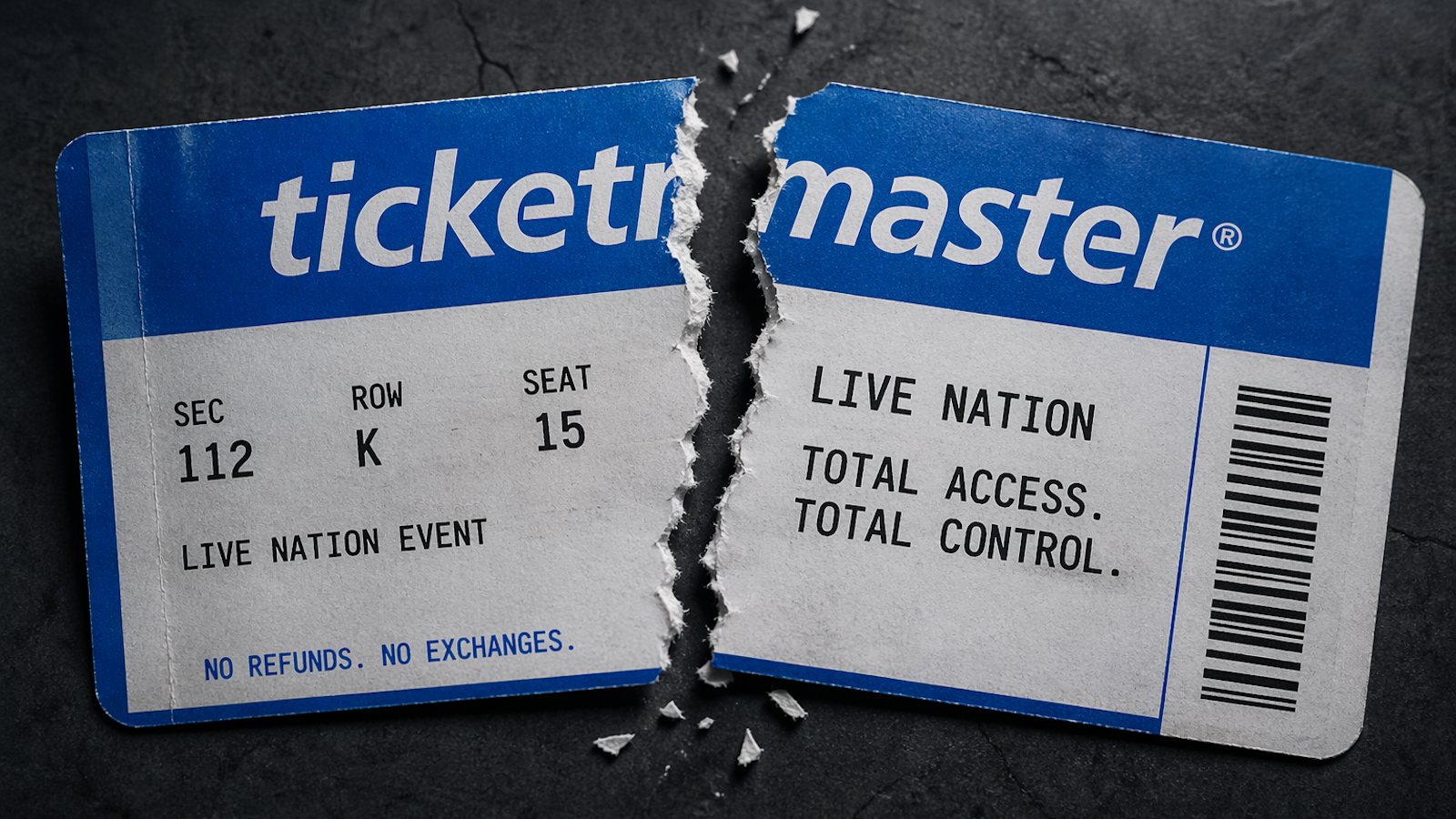
On April 15, a federal jury in Manhattan returned a verdict that surprised almost no one who had been paying attention, and stunned everyone who hadn't. After a five-week trial, jurors found that Live Nation and its subsidiary Ticketmaster had illegally monopolized the U.S. ticketing and live events markets. The vote was 10-0. The jury sided with the states on every single claim.
Within hours, fans were celebrating. Within a few more hours, analysts were tempering expectations. Ticket prices, they explained, are unlikely to drop anytime soon. Whatever remedy the judge eventually orders, it will work through a system slowly.
So if fans aren't the real winners here, who is?
The answer is not at Madison Square Garden. It's at small clubs in Portland and Boston and hundreds of other cities where independent venues spent years trapped in a system they didn't choose and couldn't escape.
What Anticompetitive Behavior Actually Means
Before getting into what Live Nation did, it helps to understand what antitrust law is actually designed to prevent.
Anticompetitive behavior is not simply about a company being large or dominant. It is more specific than that: it is when a business improves its profits through actions that do not benefit, or actively harm, the customers and market it serves.
A company that charges higher prices because it built a genuinely better product is competing. A company that charges higher prices because it eliminated every meaningful alternative is doing something else entirely.
The distinction matters because free markets are supposed to self-correct. Competition keeps prices honest. Innovation keeps products improving. But when one company controls enough of the market to remove those pressures, the correction stops working. Customers pay more. Competitors get squeezed out. And the smaller businesses that might otherwise serve that market find the doors locked.
That is the environment Live Nation spent fifteen years constructing.
The Evidence Was Hiding in Plain Sight
Anyone paying close attention to the live music industry could see the harm for years. The challenge was proving it in court.
Live Nation's position was uniquely powerful because it operated at every layer of the business simultaneously. It owned or operated hundreds of venues. It promoted the biggest tours. It managed artists. And through Ticketmaster, it controlled the primary platform through which concert tickets were sold. The DOJ's original lawsuit described this as control of "virtually every aspect of the live music ecosystem." The revenue chart below captures what fifteen years of that control looked like financially.
Live Nation Entertainment SEC Filings / MacroTrends, 2010-2025
The coercion mechanism was not subtle. If a venue wanted access to Live Nation-promoted concerts, featuring some of the biggest artists in the world, it effectively had to use Ticketmaster as its ticketing provider. Testimony during the trial described venues being warned that switching ticketing platforms could cost them major shows. Mitch Helgerson, chief revenue officer of the Minnesota Wild, testified that when his venue explored switching to a competing platform, Ticketmaster executives warned that Live Nation could redirect concerts to a competing arena nearby. He called the prospect "almost catastrophic" to consider. A competing ticketing company, SeatGeek, actually started offering independent venues something it called "Live Nation retaliation insurance," a financial guarantee to compensate venues if they lost Live Nation bookings after switching. That a company had to invent an insurance product just to help venues change their ticket vendor tells you most of what you need to know about how the market was functioning.
The cumulative effect on small businesses in the industry was severe. A study by the National Independent Venue Association found that 64% of independent venues, promoters, and festivals were not profitable in 2024. In Boston, musician Damon Krukowski watched the local landscape shift as small clubs shuttered while new Live Nation-affiliated venues opened nearby. Mid-tier and independent artists simply stopped coming to the city. There was nowhere for them to play that made economic sense.
In Portland, Maine, the Maine Music Alliance spent months fighting Live Nation's proposal to build a 3,300-seat venue in a market where that kind of capacity, backed by Live Nation's promotional power, would have absorbed the concert supply that independent stages depend on. The Alliance succeeded in getting a temporary moratorium on large venues in the city, an outcome Scott Mohler, the organization's executive director, described as a fight by people who had been dismissed as "a bunch of hippies and hipsters shouting about the corporation."
The jury did not need to be told that harm existed. It was documented in emails, in market share data, and in the testimony of people who had lived it for years.
The Government Blinked. Thirty-Three States Didn't.
When the DOJ filed its antitrust lawsuit against Live Nation in May 2024, the ask was sweeping: a forced breakup of the company, separating Ticketmaster from the concert promotion and venue businesses, unwinding a merger the government had permitted in 2010.
The trial began March 2, 2026. One week in, the DOJ reached a settlement with Live Nation for $280 million and stepped back from the case. A handful of states joined the deal.
The reaction in the independent music industry was immediate. Stephen Parker, executive director of the National Independent Venue Association, said the settlement was "not significant enough to call a slap on the wrist." Six U.S. senators wrote to the presiding judge urging him to examine whether the deal genuinely served the public interest, and raising questions about the circumstances under which it was reached. The judge himself called the settlement's timing "unacceptable" and ordered all related communications preserved.
But 33 states and the District of Columbia looked at the evidence assembled over two years of litigation and concluded it was too strong to walk away from. Joey La Neve DeFrancesco, a musician who had founded the United Musicians and Allied Workers, a grassroots union that had pushed hard for the case to continue, captured the sentiment: "It's been decades that artists have been fighting this company."
The states kept going. On April 15, the jury found Live Nation liable on every claim. The overcharge per ticket, as calculated by the jury, was $1.72 across affected venues. The verdict was unanimous.
The DOJ's settlement is not yet finalized, either. Under the Tunney Act, the judge is required to independently evaluate whether the settlement serves the public interest before it can be approved. Given what the jury just found, that review will be harder to pass.
What Actually Changes
Ticket prices will not fall next month. Live Nation has already signaled it will appeal, and any structural remedy ordered by the court will take years to work through the industry. Anyone expecting immediate relief at the box office will be disappointed.
But for the small businesses that make up the backbone of live music, the direction has shifted.
For years, a venue that wanted access to Live Nation-promoted concerts had to accept Ticketmaster's terms. That leverage is now legally documented as illegal. As the case moves into the remedy phase, independent venues have real legal footing to renegotiate their ticketing arrangements. Competing platforms that watched the market stay locked for a decade will see new openings.
For artists earlier in their careers, the implications are potentially more significant. The live music ecosystem Live Nation built was optimized for scale. Bigger tours, bigger venues, bigger fees. The independent circuit, where most artists develop their craft and their audience, was squeezed by the same system. Fewer stages and fewer shows meant fewer paths for emerging artists to build a real following before they could fill arenas.
An independent venue cannot book Beyonce, and it is not trying to. What it can do, with the right operator, is know exactly which artists its community wants to see before the industry does. It can take a chance on an act that fills 400 seats tonight and 4,000 seats in three years. It can price tickets at a level that reflects what local fans can actually afford, not the extraction ceiling of a monopoly. That knowledge of audience, that rootedness in a specific place and community, is something no vertically integrated entertainment conglomerate can replicate. It is the reason independent venues exist, and it is precisely the advantage a more open market allows them to use.
The Maine Music Alliance understood this when it blocked Live Nation's Portland expansion. A corporate venue optimized for national tours does not serve the same function as a room that has spent ten years building relationships with local artists and local fans. The verdict gives organizations like the Alliance the legal standing to keep making that argument.
The Monopoly Teenagers Could See
Here is the detail that should give every small business owner pause.
The case against Live Nation did not begin with regulators or legal scholars. It began, effectively, with a 2022 ticket sale for Taylor Swift's Eras Tour, when millions of fans, many of them teenagers, watched the Ticketmaster website collapse under demand, saw prices surge to multiples of face value, and arrived at the same conclusion in real time: this system is rigged.
They were right. It took four years of litigation, 33 state attorneys general refusing a federal retreat, and a five-week jury trial to legally confirm what 13-year-olds in every state had already figured out.
That should be unsettling. Not because the system eventually worked, but because of how long it didn't. A monopoly that visibly harmed consumers, that locked out competitors through documented coercion, that its own employees described in emails as designed to "turn a blind eye" to bad practices, required years of effort to hold accountable. And even then, the federal government settled for a fraction of what advocates sought, before a coalition of states finished the job.
So the question worth sitting with is not whether Ticketmaster was a monopoly. The jury answered that unanimously. The question is how many other companies are doing the same thing in markets that haven't yet had their Taylor Swift moment.
One of them is Amazon. In April, California unsealed evidence showing that Amazon allegedly pressured major brands to get competitors to raise their prices, protecting Amazon's margins at the expense of consumers and the small businesses selling in its marketplace. The trial isn't until 2027. The evidence is already striking.
That story is next.
Enjoyed this article?
These ideas come from Unconvention — Sri Kaza's guide to competing smart as a small business.
Copyright 2026
Sri Kaza