
Nobody's Watching Out for You
Every employee in America has a manager. Business owners have a business.
June 24, 2026

Share
Early in my career, I had too much feedback. That's not a complaint. It's just the reality of places like PricewaterhouseCoopers and McKinsey. You got structured reviews, informal coaching, lateral input from peers, and the kind of candid senior perspective that most professionals never experience. I took it for granted, and honestly, sometimes resented it. Who needs another person weighing in?
Then I became a CEO.
I had investors with financial interests in specific outcomes. A team that needed direction and confidence from me, not uncertainty. Customers and partners with their own expectations. Everyone had a stake, and everyone had a perspective shaped by that stake. What I didn't have was someone sufficiently disconnected from all of it, and sufficiently understanding of the complexity, to help me sort through what was actually in front of me.
That gap is one of the least discussed structural realities of running a business. And it turns out it doesn't get easier as you get more senior. At McKinsey, I watched the most experienced partners navigate the same problem. Not because they lacked access to smart people, but because the competitive dynamics among senior executives made real trust difficult. Vulnerability at the top carries risk. So the people who probably need outside perspective the most are often the least likely to seek it.
You Built a Development System for Your Team. Nobody Built One for You.
Think about what you've constructed for your team. Performance reviews. Regular check-ins. Coaching conversations. Feedback loops. Many business owners invest meaningfully in their employees' development, because they know that people without outside perspective get stuck.
You set all of that up for them. Nobody set it up for you.
This isn't just an emotional observation. A landmark Harvard Business Review study found that 50% of CEOs report chronic loneliness in their role. For small business owners without boards or executive teams, the rate is higher. And a 2025 academic review in the Journal of Small Business Management concluded that entrepreneurial isolation is now recognized as a predictor of business outcomes, not just a side effect of leadership. Isolated decision-makers make worse decisions.
The isolation isn't about having no one around. Most business owners are surrounded by people. It's about having no one around with the right combination of understanding and distance. Everyone inside your world has something at stake. That shapes what they'll tell you.
The Person You Need Has No Stake in the Outcome
Over the years, I've mentored and advised around 25 startups through incubator and accelerator programs, and served as a board member or advisor to several more established companies. The pattern I see most often isn't a lack of talent or effort. It's a lack of honest outside input: the kind that doesn't come filtered through someone's interest in the outcome.
The business owners who navigate hard moments best tend to have at least one person in their corner who meets a specific profile: they've been where you are, or have a skill you genuinely lack, and they don't need anything from you. Not a yes-person. Not a consultant pitching a retainer. Someone who can say "I don't think that's right, and here's why." And mean it.
The secret, by the way, is that you don't have to do what they tell you. That's not the point. The point is hearing a perspective that isn't filtered through your own assumptions or someone else's incentives. Sometimes that alone is enough to see the problem differently.
The data on this is striking in its simplicity. 93% of small business owners say mentorship is important to their success. Only 25% have a mentor. 70% of mentored small businesses survive past five years, compared to 50% that don't. The gap between knowing something matters and actually doing it is where most businesses quietly leave value on the table.
MentoringComplete, 2024; SCORE / Bureau of Labor Statistics
More Options Exist Than Most Owners Know About
The good news is that resources exist, more than most business owners realize.
Local chambers of commerce run peer programs and advisory networks that often go underutilized. University entrepreneurship programs, particularly at schools with active alumni networks, can connect owners with experienced mentors who remember what the early stages actually felt like. The SBA's SCORE program offers free one-on-one mentorship through a network of 10,000 volunteers: retired executives, former operators, functional specialists. Peer advisory organizations like Entrepreneurs' Organization and Vistage create cohorts of owners who meet regularly to pressure-test each other's thinking.
The format matters less than the fit. What you're looking for is someone who can understand the complexity of your situation, has no stake in the outcome, and will tell you what they actually think.
That last part is rarer than it sounds. Most people, when asked for feedback, default to encouragement. The mentor worth having is the one who will sit with the uncomfortable question instead of helping you resolve it too quickly.
The businesses that find these relationships tend to survive longer and grow faster. Not because mentors have magic answers, but because the quality of thinking that comes from regular outside perspective compounds over time. The decision you examine carefully, with someone who has nothing to lose, is different from the decision you make alone under pressure.
The Questions Worth Sitting With
I'm not going to tell you to go sign up for something or find a mentor by Friday. What I'll offer instead is a few questions that are worth sitting with honestly.
When was the last time you had a real conversation with someone who had nothing at stake in your business?
If you could get one clear outside perspective on something right now? One honest read from someone who doesn't need anything from you.
Who tells you what your blind spots are?
What are the problems in your business that you can't talk about with anyone who is actually involved in it?
The answers to those questions will tell you more about where you are than any survey or benchmark. And they'll tell you whether you're running your business with the kind of outside perspective that most of the people around you are quietly taking for granted.
Enjoyed this article?
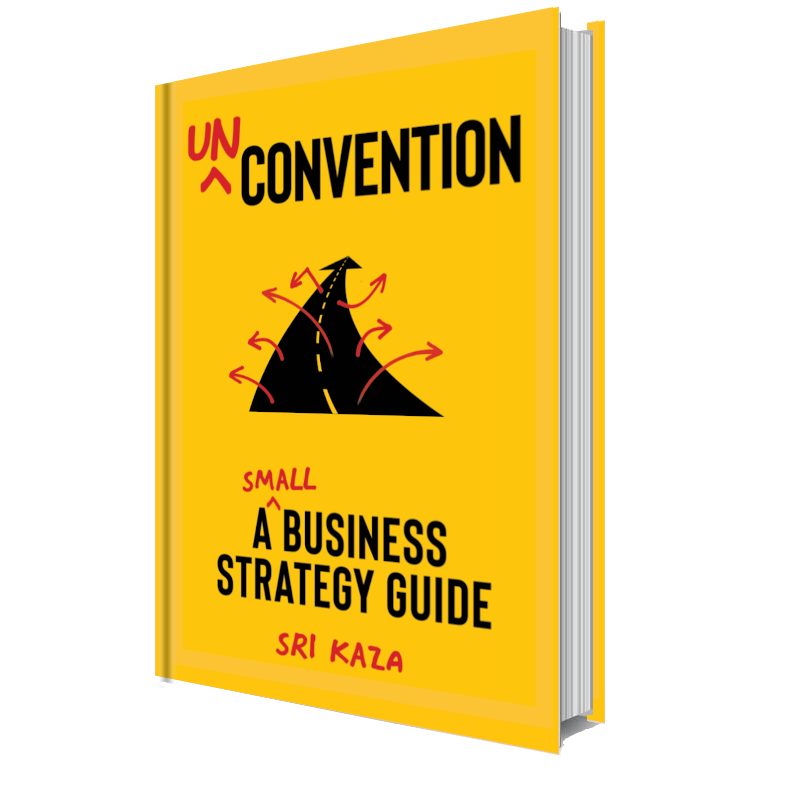
These ideas come from Unconvention — Sri Kaza's guide to competing smart as a small business.
Copyright 2026
Sri Kaza