
The Rate Cut Window Won't Stay Open
Borrowing got cheaper. The banks can't agree it'll last.
September 23, 2026
Share
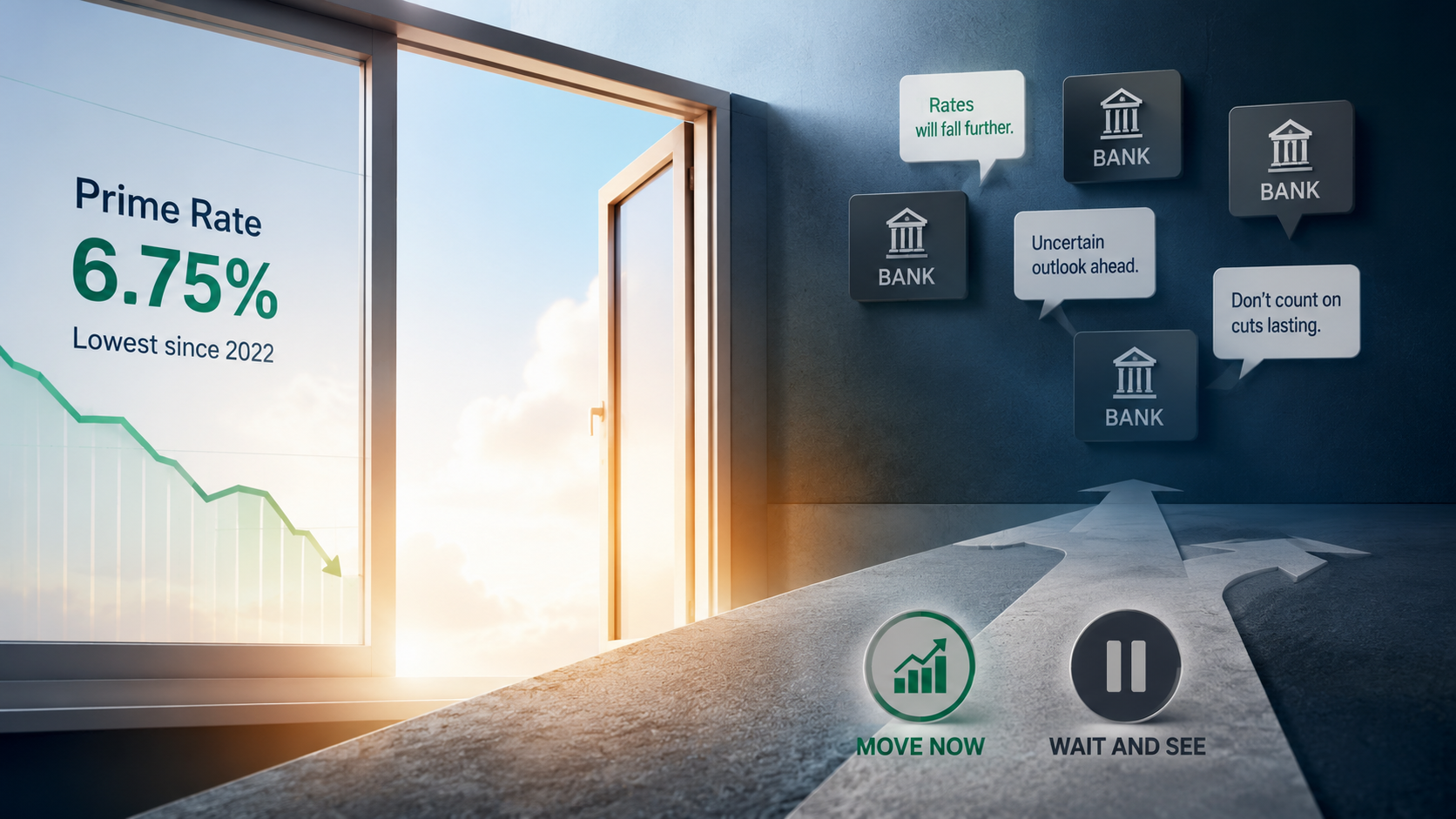
Prime dropped to 6.75 percent this year, the lowest it's been since 2022. If access to capital has been the thing standing between you and a project, it's worth asking a different question than "should I wait for it to get cheaper." It's worth asking what you'd actually do with that capital right now, if you had it.
The Rate Cut Is Real
Prime peaked around 8.5 percent in 2023 and 2024, the highest it had been in over two decades. It's been sliding down since, landing at 6.75 percent as of late July. Three Fed rate cuts in the second half of 2025 brought variable rate business loan costs down by roughly 1.75 percentage points, which works out to about $8,750 a year in savings on every $500,000 of variable rate debt outstanding, according to Bank of America's own lending data.
Federal Reserve, H.15 Selected Interest Rates / Bank Prime Loan Rate (FRED)
That's not a rounding error. It's the kind of number that can turn a project that didn't pencil out two years ago into one that does today.
Why This Might Not Last
Here's the part that's easy to miss in the good news. The people who actually set these forecasts keep changing their minds, in both directions, within months of each other.
In May, Bank of America's economists told clients they no longer expected the Fed to cut rates at all this year, citing tariffs, the Iran war, and stubborn inflation. Beth Ann Bovino, chief economist and committee chair at the American Bankers Association, said in March that inflation remains a primary source of macroeconomic risk, and that her committee's baseline expectation is that it stays above the Fed's 2 percent target for the foreseeable future. Chris Hyzy, Chief Investment Officer for Merrill and Bank of America Private Bank, put it plainly: a period of higher rates, if it happens, would make borrowing for large purchases more expensive again.
None of that means rates are about to spike back to 2023 levels. It means the professionals paid to forecast this keep revising their own calls every few months, which tells you plainly that nobody actually knows how long this window stays open.
What a Lower Rate Actually Buys You
The easy part of this story is the math. Borrowing $500,000 at today's rate instead of 2023's rate saves a real business real money every single month, money that shows up as better cash flow whether it's used to pay down other debt, cover payroll during a slow stretch, or fund the thing you've been putting off.
The harder part is the question underneath it: if capital were less of a constraint right now than it's been in three years, what would you actually do with it?
Deploying Capital When You Actually Have Access to It
Most small business owners don't sit around imagining hypothetical windfalls. But almost everyone has a mental list of things that would happen "if the money made sense." A second location. A piece of equipment that would cut production time in half. A hire that's been contingent on revenue that hasn't quite arrived yet.
Those aren't hypothetical anymore in the same way they were two years ago. A $150,000 equipment loan, a $500,000 expansion line, a working capital cushion to finally make a hire, all of it costs meaningfully less to carry today than it did at the 2023 peak. That doesn't mean the answer is automatically yes. It means the answer deserves a fresh look instead of an old one.
The Real Question Isn't Timing, It's Readiness
The instinct to wait for an even better rate is understandable, especially after a few years of getting burned by high borrowing costs. But the professionals forecasting this can't agree on where rates go next, which means waiting for certainty is waiting for something that may not come. If a project only works at a rate lower than today's, it's probably not ready regardless of what the Fed does. If it works today and didn't two years ago, the real question isn't when rates might improve further. It's whether you're prepared to act on the access you already have.
This Week
Take the thing you've mentally shelved, the expansion, the equipment, the hire, and reprice it against today's rate instead of whatever number you last checked it against. If the math works now, start the conversation with a lender this month. The forecasters disagree on almost everything else right now, but they agree the window won't stay exactly where it is indefinitely.
Enjoyed this article?
These ideas come from Unconvention — Sri Kaza's guide to competing smart as a small business.
Copyright 2026
Sri Kaza