
Give Lenders Something to Root For
Capital is available. Understand what lenders are actually looking for.
July 22, 2026

Share
If you've ever Googled "how do banks decide on small business loans," you've probably come across the Five Cs of Credit: Character, Capacity, Capital, Collateral, and Conditions. It's a tidy framework. Every bank website has a version of it.
Character is listed first, and usually described as something like: your reputation, your credit history, your track record, the overall impression you make. Which sounds reasonable until you try to act on it. How do you improve your "impression"? What does a lender mean by "character," and how would you know if yours was lacking?
When I joined ForwardLine (a small business lender) my underwriters walked me through how they actually evaluated applications. I had the same reaction most business owners have when they first encounter the Five Cs: it still felt ambiguous. The more time I spent watching decisions get made, the clearer it became. The framework is real, but what it's really measuring is simpler than the language suggests. Lenders want to know one thing: are they going to make money off of you? If your gut is telling you that's what it comes down to, you can trust your gut.
High Approval Rates and Good Terms Are Not the Same Thing
Here's the lending environment small businesses are navigating.
Large banks approve roughly 40% of small business loan applications. Online lenders approve closer to 71%. Those numbers look very different, and many business owners assume the online lender is the better path. The satisfaction data tells a more complicated story.
Borrower satisfaction is highest at community development financial institutions (CDFIs) at 72%, and at small community banks, at 68%. Online lenders, despite their higher approval rates, score well below both. The reason: high interest rates, short repayment terms, and fees that make the effective cost of capital significantly higher than the headline rate suggests.
Getting approved isn't the goal. Getting approved on terms that don't damage your cash flow is.
Federal Reserve 2025 Small Business Credit Survey
Lenders Are Scared Right Now. Your Application Enters That Context.
Banks that tightened their lending standards in 2025 cited economic uncertainty as their reason in 83% of cases. The underwriter reviewing your application isn't evaluating your business in isolation. They're evaluating whether your business will hold up in conditions they can't fully predict. That's the context every application enters.
The denial data from the Federal Reserve's 2024 Small Business Credit Survey is specific enough to be useful. Among businesses denied credit or partially funded, the most common reasons were low credit scores and elevated existing debt. The debt finding has shifted sharply since the pandemic: the share of denied firms citing too much existing debt jumped from 22% in 2021 to 41% in 2024. Businesses that took on COVID-era loans, drew down lines of credit, and carried that debt forward are now finding it follows them into every new application.
There's also a category the Federal Reserve calls "discouraged borrowers": businesses with genuine financing needs that never applied because they assumed rejection. The Fed estimates over 2 million U.S. businesses fall into this category annually. Some of those businesses would have been approved. They never gave themselves the chance to find out.
Your Job Is to Be the Least Risky Borrower in the Room
Here's the thing about the Five Cs that most guides don't tell you: interest rates and loss rates drive every decision a lender makes. That's not cynical. It's just the business model. A lender's job is to price risk accurately. The more risk they see in your application, the higher the rate they'll charge to offset potential losses. If the risk exceeds what any rate can justify, they'll decline.
This reframes the entire application process in a useful way. You're not trying to convince a lender that your business is great. You're trying to demonstrate that you're the least risky borrower in the room. The lender who sees you as low risk will offer you the best terms. Finding that lender, the one whose risk model fits your business profile, is as important as the application itself.
Community banks and CDFIs tend to price risk with more context than algorithms allow. A relationship lender who has seen your account for two years, watched you manage a difficult quarter, and seen you pay back a line of credit has a different picture of your risk than a fintech platform evaluating last year's tax return. That picture takes time to build, which means the relationship that matters most is the one you build before you need it.
Opening a business checking account at a community bank is a start. Meeting with a commercial lender when you don't need anything, to introduce the business and ask what would make you a stronger candidate, is a start. Borrowing a small amount and repaying it cleanly establishes a track record that larger requests can build on later.
At ForwardLine, and across the lending industry broadly, repeat borrowers were consistently treated as lower risk than first-time applicants, and frequently offered lower rates as a result. The business that had borrowed before, repaid cleanly, and came back for a second round had already answered the question lenders most want answered: will you pay us back? That track record is worth building deliberately, even when you don't need the money.
History Beats Projection, Every Time
Here is something most business owners don't understand about how lenders read a loan package: they put far more weight on your history than your future.
A well-designed financial projection will not overcome three years of uneven cash flow. What it can do is help a lender understand the story behind the numbers. That's the difference between submitting financials and building a financial narrative.
Your tax returns and bank statements are raw data. The underwriter's job is to construct a story from that data about whether your business can service new debt while continuing to operate. If you don't provide that story yourself, they'll build it from whatever they can see, which may not reflect the context, decisions, and trajectory that make your business a good credit.
A strong loan package explains the anomalies. A bad year with a specific, resolved cause reads differently than a pattern of decline. A revenue dip followed by a documented recovery is a different story than a revenue dip that simply stops. You know why your numbers look the way they do. The lender doesn't, unless you tell them. Specificity is what turns a history into a case.
The Timing Problem Nobody Talks About
Here's a data point worth sitting with. According to the Federal Reserve's 2025 Small Business Credit Survey, the single most common reason small businesses sought financing was to meet operating expenses, cited by 56% of applicants. Pursuing an expansion or new opportunity came in at 46%.
More than half of all small business loan applications come from businesses trying to cover costs they can't cover themselves. Lenders know this. They can see it in the numbers, and they can sense it in the conversation. An application driven by necessity looks different from an application driven by opportunity: different financials, a different narrative, and different terms.
Federal Reserve 2025 Small Business Credit Survey
This isn't a criticism of businesses in that position. Cash flow pressure is real, and the timing of when you need money is not always within your control. But the businesses that access capital on the best terms are mostly the ones that applied before they needed it: when the balance sheet looked strong, the story was about growth rather than survival, and there was time to shop lenders rather than take whatever was available.
Desperation is legible. Lenders read it in the numbers before you say a word. The application that arrives under pressure gives them something to protect against. The one that arrives from a position of strength gives them something to approve.
If you haven't spoken with a commercial lender in the last 12 months, put it on the calendar this week. Not to apply. Just to introduce your business, ask what they look for in a strong borrower, and find out what your file would need to look like to get the best terms. That conversation costs you an hour. Having it before you need to borrow is one of the more asymmetric investments you can make in your business.
Enjoyed this article?
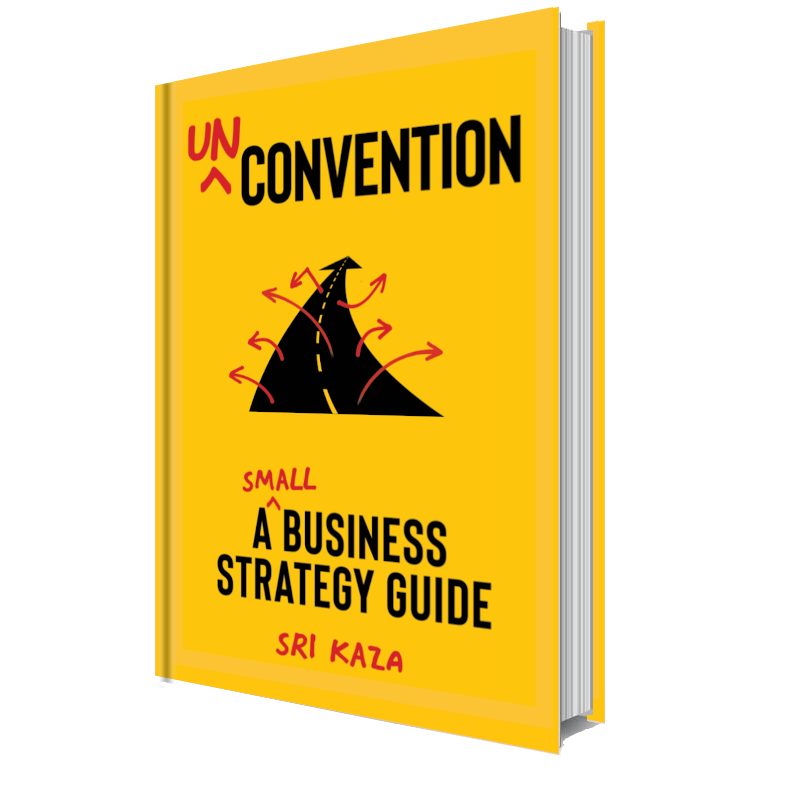
These ideas come from Unconvention — Sri Kaza's guide to competing smart as a small business.
Copyright 2026
Sri Kaza