
Two Economies
Which one(s) are you in?
January 20, 2026

Share
In December, I reflected on the most important lesson I learned in 2025: there are two economies, not one. It triggered a lot more responses than I expected—people told me how the economic news, and reporting on national sentiement and behavior felt disconnected from their daily reality.
So, many of you asked for more detail... What does this split actually look like? How do you identify which economy your customers live in? And most importantly, how should this shape your 2026 planning?
Let me show you what I mean through data, not theory.
The Divide Starts With Numbers
Approximately 13.7 million American households—about 10% of all households—earn more than $251,000 annually. These households have a median income well above the threshold, often exceeding $350,000 when you look at the top 5%.
The other 122 million households—the remaining 90%—have a median income of $83,592. Not average, median. Half earn more, half earn less.
This isn't just inequality. It's two fundamentally different economic experiences. And the gap between them is driven by a single, powerful predictor.
Education Is the Dividing Line
The strongest predictor of which economy you participate in isn't geography, industry, or even age. It's educational attainment—specifically, whether you hold an advanced degree.
Bureau of Labor Statistics, 2024 data on median earnings and unemployment rates by educational attainment
Workers with high school education or less earn a median of $52,000 annually and face unemployment rates around 4%. Those with bachelor's degrees earn $80,236 with unemployment at 2.5%. But workers with advanced or professional degrees earn $105,000+ and face unemployment of just 1.8%—essentially full employment with significant wage premiums.
This matters because educational attainment increasingly determines not just income, but economic stability, housing security, and spending power. The bachelor's degree has become the minimum entry point to the affluent economy.
And Those People Drive Half the Economy
Here's where it gets consequential for your business. By the second quarter of 2025, the top 10% of households drove 49.2% of all consumer spending. That's the highest concentration since the Federal Reserve started tracking this data in 1989.
Moody's Analytics & Federal Reserve Consumer Expenditure Data
What makes this remarkable isn't just the top 10%'s dominance—it's what happened to everyone else. The bottom 80% of households saw their real spending (adjusted for inflation) remain essentially flat over the past five years. They're not cutting back dramatically, but they're not growing either. They're treading water.
This wasn't always true. Through the 1990s and 2000s, middle-income spending grew alongside the economy. But something fundamental shifted after the 2008 financial crisis, and it accelerated dramatically during the pandemic.
Housing Burden Compounds Everything
Housing costs cement these differences into place. Lower-income households don't just earn less—they spend a far greater share of their income on housing, leaving less for everything else.
U.S. Census Bureau American Community Survey 2024 & Congressional Research Service analysis
Households earning under $30,000 annually spend nearly 48% of their income on housing. Those earning $30,000-$45,000 spend 38%. Even middle-income households earning $45,000-$75,000 spend 32%—well above the 30% threshold that HUD defines as "cost burdened."
Meanwhile, households earning over $150,000 spend just 18% of their income on housing. They're not just wealthier—they have fundamentally more discretionary income to spend on everything else. And if they own homes, they're building equity while paying proportionally less.
This creates a compounding effect. Higher earners see their net worth grow automatically through home equity while paying proportionally less for housing. Lower earners see more of their paycheck disappear into housing costs that build no wealth.
The Behavioral Evidence Makes It Undeniable
At this point, the data makes clear: we're not looking at one economy with variation. We're looking at two distinct economic realities. And corporate earnings calls in late 2025 made this impossible to ignore.
Corporate earnings reports (McDonald's, Darden, American Express, Q3 2025)
McDonald's CEO reported that customers earning under $45,000 were "under pressure" while middle and high-income consumers showed "no behavior change." Darden Restaurants (Olive Garden, LongHorn) saw transactions increase for households earning over $150,000 while declining for those under $50,000. American Express reported overall spending up 6% but premium airfare bookings up 11%.
Federal Reserve Governor Christopher Waller captured it perfectly in November: "Talk to retailers in the top third of the income distribution and they'll tell you everything's great—they can pass through cost increases no problem. Talk to retailers serving the lower half and they'll ask 'what happened?'"
These aren't just income brackets—they're fundamentally different economic realities. The Economy of the Affluent features job security, rising asset values, discretionary spending power, and optimism about the future. The Economy of Everyone Else faces employment uncertainty, stagnant real wages, housing cost pressure, and limited discretionary spending.
Don't Run a Focus Group in Your Head
A colleague of mine used to warn about a common mistake in business strategy: running a focus group in your head. You imagine how customers will respond based on how you would respond. You assume their constraints, preferences, and decision-making processes mirror yours.
The two-economy reality makes this mistake far more dangerous. Many people making decisions, developing products, and crafting solutions participate in the more affluent economy. They hold advanced degrees, own homes, earn household incomes above $100,000, and have the discretionary income to absorb price increases or invest in premium experiences.
Yet they're accountable to serve people participating in a fundamentally different economy—both as customers and as employees. Those customers are hunting for deals, trading down when possible, and making purchasing decisions based on immediate necessity rather than aspiration. Those employees are working second jobs, asking about raises, and facing housing cost burdens that consume 35-40% of their paychecks.
The question for business owners isn't "what would I do?" The question is "what would someone in my customer's economic reality do?" And the only way to answer that is to actually know their reality.
The Advantage of Proximity
This is where small business owners have a genuine advantage over national retailers: you can actually know the answer. You don't need to interpret aggregate data or run sophisticated analytics. You can ask. You can observe. You can listen.
Think about your customer conversations over the past year. Are they asking about payment plans more often? Choosing lower-priced options than they used to? Mentioning that their household income situation has changed? Those are signals.
Look at your transaction data. Are average ticket sizes declining? Are customers buying less frequently? Are they trading down from premium to standard offerings? More signals.
Talk to your employees. Have their personal financial situations changed? Are they working second jobs? Asking about raises or better benefits? Your employees often live in the same economic reality as your customers.
This isn't market research—it's proximity. You have direct access to information that no national dataset can provide. Use it.
Planning for 2026: Three Questions
First, which economy do your core customers live in? Not your ideal customers or your highest-value customers—your core base. If they're in the Economy of Everyone Else, expect continued price sensitivity, slower transaction growth, and pressure on margins. If they're in the Economy of the Affluent, expect willingness to pay for quality, premium positioning opportunities, and relative stability.
Second, which economy do your employees live in? This determines your 2026 labor strategy. If your employees face housing cost pressure and stagnant wages while your business serves affluent customers, you're vulnerable to turnover. If you can't match corporate wages, can you offer flexibility, proximity to home, or genuine appreciation that large employers can't?
Third, are you positioned correctly for the economy you serve? Don't try to be premium when your customers need value. Don't compete on price when your customers value quality. The misalignment between business positioning and customer economic reality is where businesses fail in split economies.
The Plot Twist
Throughout most of 2025, high-income consumer sentiment remained remarkably resilient even as middle and lower-income consumers pulled back. The University of Michigan's sentiment survey showed the top tercile maintaining confidence scores above 85 while the bottom tercile hovered in the low 50s.
But November brought something unexpected.
University of Michigan Consumer Sentiment Survey, 2025
High-income sentiment dropped 32.1% from January through November—the steepest decline of any income group. Meanwhile, bottom-tercile sentiment actually stabilized and began ticking upward. The exception? Consumers with the largest stock holdings saw sentiment jump 11% in November alone, suggesting the affluent economy itself is splitting between those whose wealth is tied to financial markets and those whose wealth comes from wages.
This creates new planning uncertainty for 2026. Is the affluent economy beginning to crack? Or is this temporary volatility in an otherwise stable segment? The answer will reveal itself through your direct customer relationships—another advantage of proximity.
What This Means for Your Business
National economic data won't guide your 2026 decisions. Half the country will point to strong consumer spending and stock market performance. Half will point to persistent inflation and wage stagnation. Both will be right—because they're describing different economies.
Your advantage is that you don't need to reconcile the national narrative. You need to understand the specific economy your customers and employees live in, then make decisions aligned with that reality.
Don't assume your customers think like you do, respond like you would, or prioritize what you prioritize. Don't run a focus group in your head based on your own economic reality. Instead, use your proximity to understand their reality directly.
Listen to what your customers tell you about their situations. Watch how their behavior changes. Ask your employees what economic pressures they're facing. This direct intelligence is more valuable than any national dataset.
Then plan accordingly. If your customers are in the Economy of Everyone Else, optimize for value, efficiency, and reliability. If they're in the Economy of the Affluent, invest in experience, quality, and differentiation. And if the data suggests the affluent economy is beginning to soften, prepare contingency plans.
The aggregate economy will continue to send mixed signals. But your economy—the one your business actually operates in—will tell you exactly what you need to know. You just need to pay attention.
Enjoyed this article?
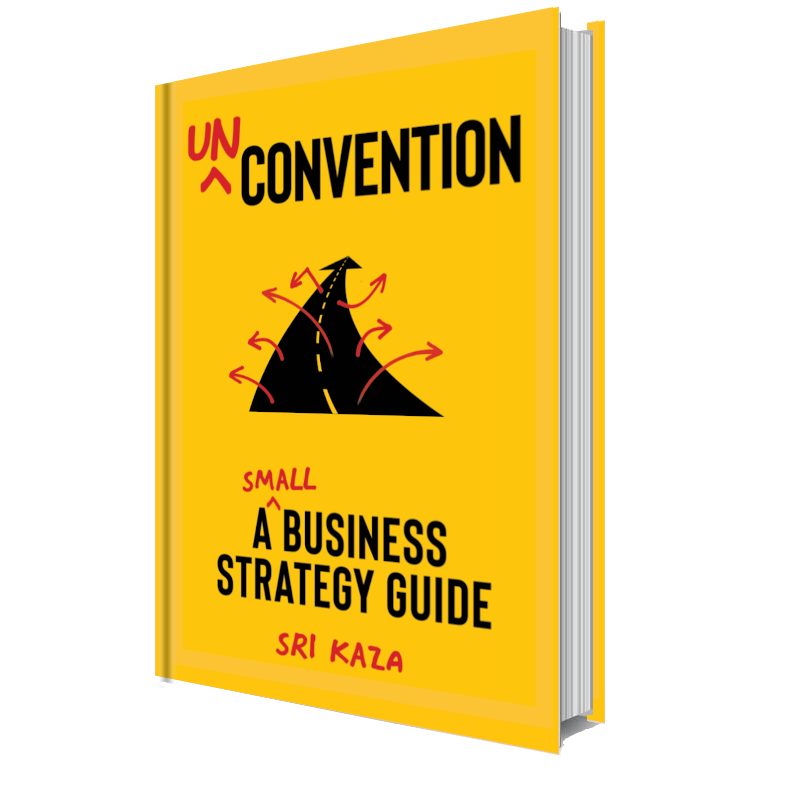
These ideas come from Unconvention — Sri Kaza's guide to competing smart as a small business.
Copyright 2026
Sri Kaza