
Your Competitors Are Buying AI Tools. That's a Mistake.
Why the smartest AI move for a growing business starts with the work, not the software
September 29, 2026

Share

Meet Dana. She runs a 45-person commercial HVAC company in New Jersey, the firm her father started in 1988. (Dana is a composite, but if you run a company like hers, you'll probably recognize her.)
Over the past year, Dana has heard the same message from every direction. Her industry association ran a session on AI. Her software vendors keep adding "AI features" to their renewal quotes. Her nephew tells her she's falling behind. And the big national competitors in her market, the ones with private equity money behind them, keep announcing AI initiatives with names that sound like space missions.
So Dana did what seemed sensible. She started shopping. She sat through demos and signed up for a couple of free trials. She bought licenses for a popular AI assistant for her office staff.
Six months later, a few people use it to clean up emails. Nothing about how things actually run has changed. Dana concluded that AI is for bigger companies.
She's wrong about that. So what happened?
Throw out the big players' script
Dana copied the approach large corporations use: start with the technology, then look for places to put it. That works, sort of, when you have an innovation team, a consulting budget, and the patience to run dozens of pilots knowing most will fail. A big company can afford to buy first and figure it out later.
Smaller enterprises like yours can't, and more importantly, you don't need to. You have an advantage the giants would pay a fortune for: you know intuitively how your business works. You know which tasks eat your week, where jobs get stuck, which customer calls cause headaches, and which reports nobody has had time to build. At a large company, that knowledge is scattered across departments and layers of management. In yours, it sits in a handful of heads, including yours.
That's why the best place to start with AI isn't a tool. It's your own operation.
Begin with the work
When I help owners find where AI fits, we skip the product demos and focus on three kinds of challenges.
The recurring time sinks. These are the tasks that are necessary, repetitive, and draining: writing up job summaries, chasing paperwork, answering the same customer questions, reconciling information across systems. At Dana's shop, it turned out her dispatcher spent close to a full day each week rebuilding the schedule by hand after cancellations. It's the kind of task nobody brags about fixing, but it's precisely what AI can take on today.
The decisions that stall. Every business has questions that should be easy to answer but aren't, because the information lives in three different places. Which customers are most profitable? Which jobs run over budget, and why? Dana had a gut feeling that certain service contracts were losing money, but pulling the numbers would have taken her bookkeeper days. With AI that can read across spreadsheets and systems, that's now closer to an afternoon.
The work you've been ignoring. This is the category that gets overlooked most, and it may be the most valuable. It's the project you've wanted to tackle for years but never had the bandwidth for: analyzing why customers leave, organizing decades of job records, documenting how your best technicians troubleshoot. As Sri showed in Bring a Slingshot to the AI Arms Race, connectors that link the AI assistant you already use to your own data are helping owners finally look at parts of the business they'd been avoiding. For Dana, it was maintenance contract renewals that her team kept meaning to follow up on but rarely did. That alone was worth real money.
Notice that none of these started with "What can this AI tool do?" They started with "Where are we hurting, and where are we leaving value on the table?"
Sort before you spend
Once Dana had her list, the next step was deciding what to do about each item. I encourage clients to categorize every opportunity into one of three buckets.
Ignore, for now. Some ideas sound exciting but don't solve an actual problem, or the technology isn't reliable enough yet for work where mistakes are costly. Setting these aside isn't falling behind. It's discipline.
Revisit later. Some opportunities are legitimate but not urgent, or depend on something else happening first, like cleaning up your data or replacing an aging system. Put a date on the calendar to check back.
Invest now. These are the handful of opportunities where the pain is obvious, the payoff is measurable, and the technology is ready. For most, that's one to three things, not twenty.
Dana landed on two investments: the scheduling issue and the contract renewals. Both were modest, both paid off within a few months, and both had something her original software purchase lacked. Her team could see exactly why they mattered.
Your advantage is focus
The big players in your market will keep announcing ambitious AI programs. Some will work. Many won't, and you'll never hear about those. Meanwhile, the owner who picks two or three obstacles she understands deeply and solves them well can pull ahead, quietly.
You don't need a bigger budget. You need a clear view of your own business, and you already have more of that than any behemoth does.
Questions to think about
- Before you sit through another AI demo, consider these:
- If you could hand off one recurring task tomorrow, which would it be, and who on your team would get their time back?
- What question about your business do you wish you could answer, but never have the data handy for?
- What project have you put off for years simply because no one had the capacity?
- Where does your business depend on knowledge that lives in only one person's head?
- If you could make just one AI investment this year, what problem would you want it to solve?
Enjoyed this article?
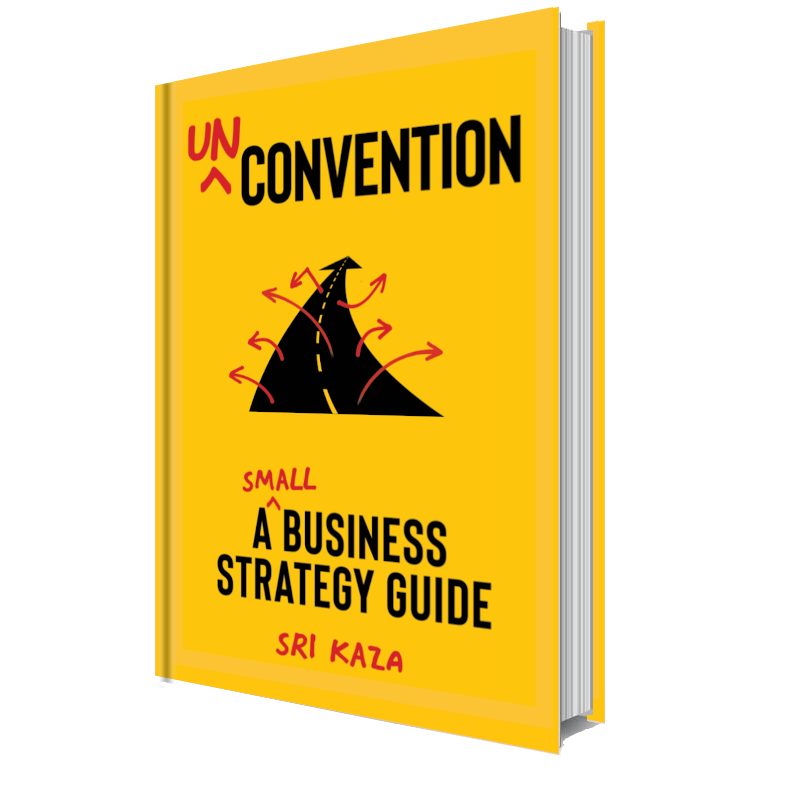
These ideas come from Unconvention — Sri Kaza's guide to competing smart as a small business.
Copyright 2026
Sri Kaza