
The Squeeze on American Farmers
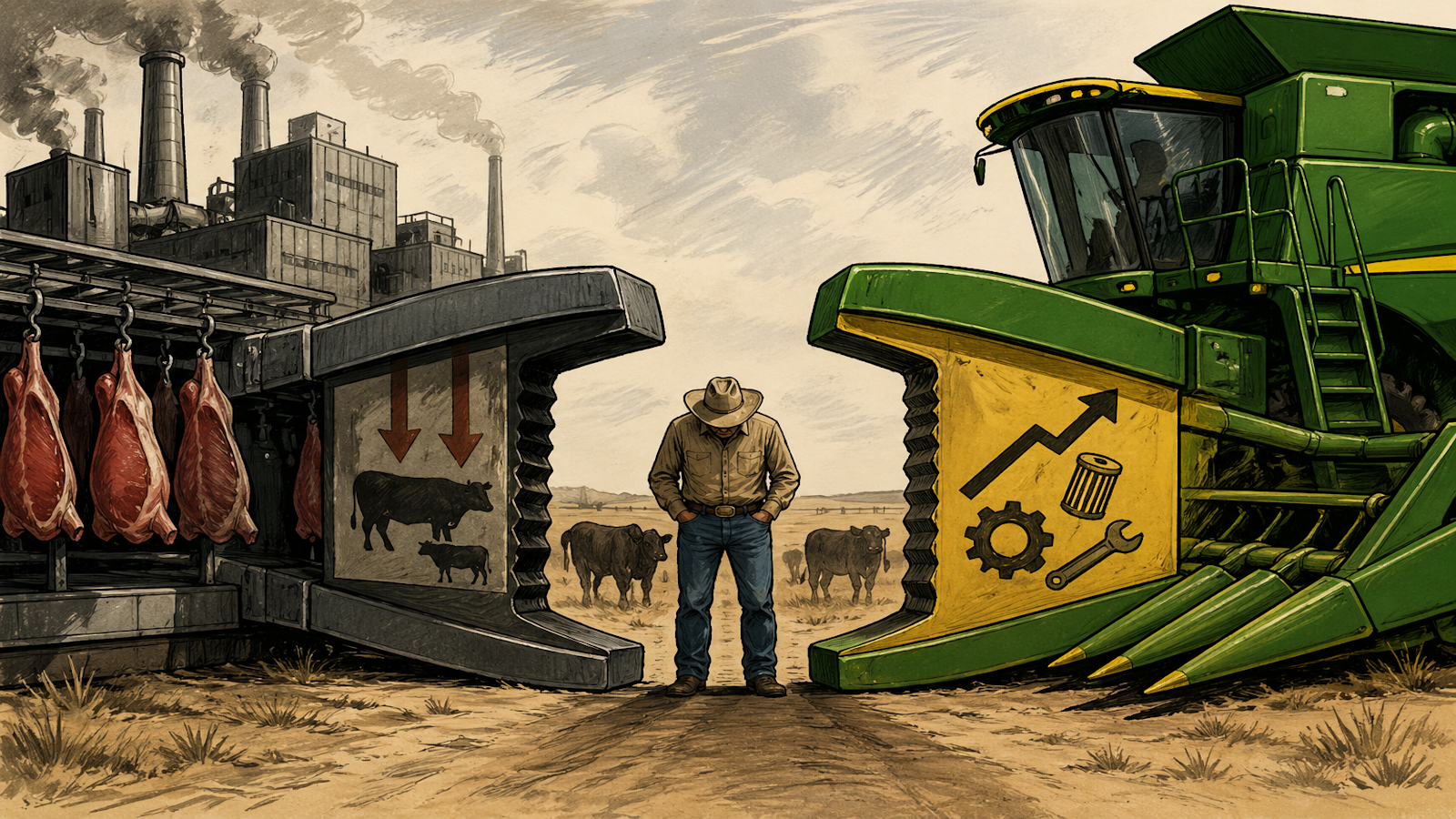
The same farmer. Two chokepoints. No alternatives.
May 27, 2026
Share
Shad Sullivan raises cattle in Olney, Texas. He's 47, and he has bone marrow cancer. When you ask him how business is going, he'll tell you he stopped paying for cable TV. Stopped taking vacations. Stopped going to movies. He's thought seriously about dropping his health insurance.
Meanwhile, the beef he raises is selling at the grocery store for record prices.
Sullivan isn't alone. The gap between what ranchers are paid for cattle and what consumers pay for beef is the largest it has ever been, according to the U.S. Department of Agriculture. Eight ranchers in seven states, interviewed by the Midwest Center for Investigative Reporting, reported stagnant or declining profits despite rising consumer prices. The math doesn't add up, until you look at who's sitting in the middle.
This series started with Ticketmaster and Amazon — companies that used market position to extract more than a competitive market would ever allow. It's tempting to think of that kind of behavior as a tech-industry habit, something that happens when venture capital and platform economics combine in Silicon Valley. It isn't. The instinct to control a chokepoint and charge whatever the captive market will bear is not a product of any particular industry. It's a product of opportunity. Given the right structure and enough time, companies in any industry will do exactly the same thing. The beef industry is just one of the oldest examples of it working.
Four Companies You've Never Heard Of
JBS. Tyson. Cargill. National Beef. These four companies process 85% of the beef consumed in the United States. Most consumers couldn't name a single one. Two of them are Brazilian-owned.
In 1980, the top four meatpackers controlled 36% of the U.S. beef market. By 1992, that share had jumped to 71%. Today it sits at 85% and still growing. That kind of concentration doesn't happen by accident. It happens when companies have the capital to build plants so large that competitors can't match the economics, and when the geography of cattle farming means ranchers have no practical alternative to the nearest large processor.
USDA Economic Research Service; R-CALF USA; American Farm Bureau Federation
The result is a market that operates more like a toll booth than a competitive auction. Cattle ranchers in a given region often have one or two realistic buyers for their animals. Those buyers know it. Lee Reichmuth runs a feedlot in Lindsay, Nebraska, with anywhere from 2,500 to 3,500 head. He sells to all four major packers. "We can't continue to buy cattle and produce food for the consumer and lose money doing it," he said. He told reporters he wasn't sure how much longer he'd stay in the business.
The packers have faced consequences for this. Sort of. Tyson and Cargill paid $87.5 million to settle a class-action price-fixing lawsuit. JBS paid $83.5 million to settle another. Neither company admitted wrongdoing. Fines paid, case closed, structure unchanged.
This week, the Department of Justice opened a criminal investigation into the Big Four for potential price fixing and collusion in cattle auctions. Criminal. That's a different level of scrutiny than the civil cases that have cycled through without resolution for two decades. It may lead somewhere. It may not. A previous DOJ investigation into COVID-era pricing closed without charges.
Bill Bullard, CEO of R-CALF USA, which represents ranchers, has been fighting this for most of his career. "We've been trying to get the administrations to do this for two decades," he said when the investigation was announced. "It's a very positive step, but it's only one of many steps that need to be taken."
The Brand on the Birthday Cake
Meatpackers are nameless to most Americans. It's hard to feel the weight of a harm caused by a company you've never heard of. But the second squeeze on American farmers is coming from one of the most beloved brands in the country.
John Deere has been making farm equipment since 1837. The green-and-yellow logo is on baseball caps, children's toys, and the walls of farmhouses across the country. Farmers grew up on Deere tractors. Some have sons and daughters who grew up on the same machines.
Over the last two decades, Deere quietly turned those machines into something else: a captive subscription to their dealer network.
As tractors and combines became more computerized, Deere built a proprietary diagnostic tool called Service ADVISOR into its equipment. When something goes wrong, the machine throws an error code. Clearing that code and authorizing the repair requires Service ADVISOR. Until recently, Deere made Service ADVISOR available only to its authorized dealers.
Farmers who spent $500,000 on a combine they legally owned found they couldn't fix it themselves. They couldn't take it to an independent mechanic. They had to call a Deere dealer, wait for a Deere dealer, and pay a Deere dealer. During the three-week harvest window when a single day of downtime can cost thousands of dollars, that dependency isn't an inconvenience. It's leverage.
Nathan Proctor, senior director of U.S. PIRG's Right to Repair campaign, has a name for Deere's justification of this arrangement. He calls it the "benevolent monopoly." His version: John Deere locked you out of equipment you paid several hundred thousand dollars for because they're just worried about you and have your best interests at heart. That's cold comfort, he added, to a farmer whose combine is stuck in limp mode during harvest, waiting for a dealer to come out and plug in a computer and hit a button.
Earlier this month, John Deere agreed to pay $99 million to settle a class-action lawsuit covering farmers who paid for dealer repairs since 2018. Deere admitted no wrongdoing.
For context: Deere's net income in fiscal year 2024 was $7.1 billion. The $99 million settlement is roughly 1.4% of a single year's profit. Gay Gordon-Byrne, executive director of the Repair Association, noted that a check you can write for 1.4% of annual income doesn't change your business model. It's the cost of doing business exactly the same way.
The FTC filed a separate lawsuit against Deere in January 2025 that remains active. A federal judge rejected Deere's motion to dismiss last June. That case is heading to trial. How does trapping your customer in the dealer network help them? That's a question Deere will eventually have to answer under oath.
The Same Farmer, Caught Twice
It's worth pausing to put these two stories together, because they aren't separate.
The cattle rancher in Olney, Texas is also a farmer using equipment. The feedlot operator in Lindsay, Nebraska is buying parts and scheduling dealer visits between cattle sales. The same producer who can't get a fair price for what they sell is also paying above-market costs for what they need to operate.
Squeezed on the revenue side by four processors who control the only market available. Squeezed on the cost side by a manufacturer who controls the only tool available. This is what market dominance looks like when it compounds.
Neither set of companies achieved this through a dramatic moment of villainy. The meatpackers grew their market share over four decades through consolidation that each administration reviewed and most allowed. Deere built genuinely impressive precision agriculture technology, then used software ownership to extract revenue that the market alone wouldn't generate. The pattern is familiar. The industry is different. The farmer caught between them is the same.
What's Actually Changing
Not enough. But a few things are worth knowing.
Direct-to-consumer beef sales have grown as ranchers look for ways around the packer chokepoint. Selling beef by the quarter or half directly to families and restaurants doesn't replace the commodity market, but it preserves margin and builds customer relationships that processors can't replicate or take away.
Colorado passed the first state right-to-repair law for agricultural equipment in 2023. Twenty states introduced similar bills in 2025. The progress is real and slow at the same time. In the meantime, some farmers have quietly started buying older tractors that predate the software era. In Wyoming, one farmer reported using a 44-year-old John Deere to harvest hay in 2022. "It still runs great," he said, "and it's got everything I need, including air conditioning in the cab."
The criminal meatpacking investigation is new territory. Prior investigations fizzled. This one carries a higher charge, though the history here counsels caution.
Sullivan's read on all of it was measured. "Issues from concentration did not come about overnight," he said, "and they're not going to be fixed overnight."
He's right. And while the system catches up, the most durable thing any farmer or small business owner can do is reduce the number of chokepoints where someone else holds the leverage. That question, and what it looks like across industries, is what the next piece in this series is about.
Enjoyed this article?
These ideas come from Unconvention — Sri Kaza's guide to competing smart as a small business.
Copyright 2026
Sri Kaza