
When the Platform Becomes the Predator
Big Tech built dominance by being useful. Here's what comes next.
June 10, 2026
Share
Over four articles, this series has looked at the same story playing out in four different industries. Ticketmaster used its control over live event ticketing to extract fees that no competitive market would have tolerated, from artists, venues, and fans alike. Amazon built the world's most efficient marketplace, then turned it into a toll booth once sellers couldn't afford to leave. Four meatpackers consolidated quietly over four decades until they controlled 85% of U.S. beef processing and could set cattle prices with no meaningful pushback from ranchers. John Deere put a software lock on equipment farmers owned, then charged them to use the tool needed to fix it.
The harm in each case landed on two parties: small businesses trying to compete, and consumers who thought the market was working in their favor. Often they were the same person. The rancher paying above-market repair costs was also a consumer paying record beef prices at the grocery store.
None of these companies started as villains. That's the part worth sitting with. They all started by being genuinely better than the alternatives. They earned trust, built dependency, and then, once the structure was in place, they changed the terms. The behavior follows the conditions, not the character.
So here is the framework the prior three articles collectively built.
The Conditions That Predict Extraction
Bad behavior doesn't require a boardroom conspiracy. It requires a specific set of business conditions, and when those conditions are present, extraction follows as reliably as water running downhill.
The first condition is consolidation past the point of practical alternatives. The number doesn't have to reach 100% monopoly. It just has to reach the point where switching is effectively impossible for the party that depends on the dominant player. Ticketmaster didn't own every venue in America. It just owned enough of the important ones that artists couldn't build a touring career around the rest.
The second condition is dependency built before extraction begins. Every case in this series started with genuine value creation. The platform earned trust and built reliance first. Extraction came only after the switching cost was high enough that the dependent party was effectively captive. Amazon's fees were reasonable for years while sellers were building their storefronts and customer bases on the platform. The fee increases came after.
The third condition is control of a chokepoint between a business and something it must have. Customers. Market access. Equipment that works. Distribution. The specific chokepoint varies. The structure is identical. Without access to the chokepoint, the business on the other side of it cannot function.
When all three conditions are present, the fourth element isn't strategy. It's math. A captive market plus a profit motive equals extraction. It doesn't require malice. It barely requires a decision. It just requires someone to run the numbers.
What extraction looks like in practice: fees rise without corresponding value increases. Quality degrades but customers have no exit. Settlements happen without structural change. The gap between what the dominant player earns and what the dependent party earns widens, year after year, with no corrective mechanism in sight.
Two Companies That Pass the Test
Google and Meta are two of the most valuable companies in the history of capitalism. Both built dominance by being genuinely, demonstrably useful. Google made finding information effortless. Facebook connected people to friends, family, and communities in ways that felt, for a long time, like a gift.
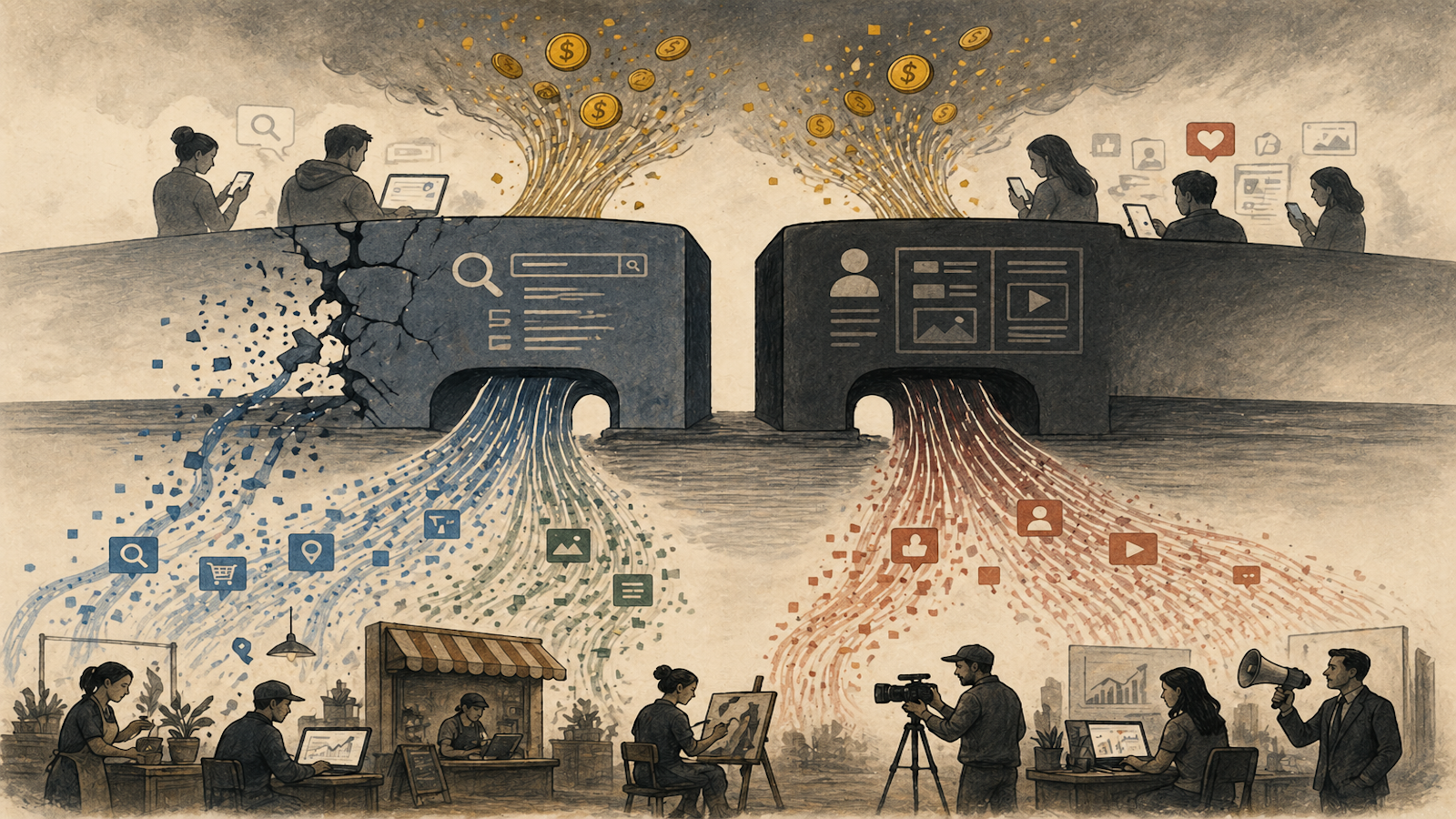
Both companies also pass the conditions test above. Both control chokepoints between small businesses and the customers those businesses need to reach. And both have already begun the extraction phase, though neither faces the regulatory conclusion that Ticketmaster and Amazon are now confronting.
Start with Meta, because its playbook is the more explicit of the two.
In the early years of Facebook Pages, Meta actively encouraged businesses to invest in building audiences on its platform. The pitch was compelling: reach customers where they already spend time, build a following, grow organically. Businesses responded. Restaurants, boutiques, service providers, and local shops spent years creating content, growing pages, and accumulating followers. By 2012, the average Facebook business page reached about 16% of its followers with any given post.
Then Meta began systematically reducing that reach. By 2024, the average organic reach for a Facebook business page had fallen to 1.37%. The followers didn't leave. Facebook simply stopped showing them your content unless you paid for it.
Facebook organic reach benchmarks: Social Status (2024), Skai / 2,500+ Pages Study (2022), industry tracking data (2020), Facebook VP Brian Boland / company disclosure (2012)
Meta's own Widely Viewed Content Report confirms the mechanism: 96.7% of the most-viewed content in Q2 2024 had no external links. Facebook's algorithm rewards content that keeps users on Facebook. Content that tries to send users somewhere else, to a business website, a menu, a booking page, gets suppressed.
The sequence matters: Facebook invited businesses to build audiences on its platform. Those businesses invested years of time and content building those audiences. Then Facebook put those audiences behind a toll booth and started charging for access. This isn't a platform maturing. It's a business model converting organic reach into a recurring advertising expense, using follower lists that the businesses themselves created. The followers are still there. You just can't reach them without paying Meta.
Google's version is less visible but equally structural. For two decades, Google's search engine operated on an implicit compact with the open web: create good content, earn good rankings, receive traffic. Publishers, bloggers, local businesses, and independent content creators built entire business models on that compact. Google sent traffic. They created content. The relationship was, if not equal, at least reciprocal.
In May 2024, Google began rolling out AI Overviews at scale, placing AI-generated summaries at the top of search results pages. The summaries draw from content across the web to answer user questions directly. The user gets the answer. Google keeps the user. The publisher or business whose content was used to generate the answer receives no traffic.
The numbers are not subtle. Zero-click searches, where users get their answer without visiting any website, rose from 56% to 69% in a single year. When an AI Overview appears, click-through rates drop from 15% to 8%, according to Pew Research tracking of 68,000 actual searches. A small home improvement blog called Charleston Crafted lost 70% of its traffic between March and May 2024, and 65% of its ad revenue along with it. Publishers surveyed by the Reuters Institute expected Google search traffic to decline by 43% on average over the next three years. Helen Havlak, publisher of The Verge, said it plainly: "The extinction-level event is already here."
Google's response has been to argue that the clicks it does send are higher quality. That may be true. It is also convenient.
The Asymmetry
Here is where Google and Meta differ, and why that difference matters.
Google's dominance is built on a single promise: the best answer. When users believe Google is delivering on that promise, they stay. When they believe something else has a better answer, the switching cost is trivial. One new URL in the address bar.
That vulnerability is real and growing. Google's search market share fell below 90% for the first time since 2015 in Q4 2024. ChatGPT now processes somewhere between 250 and 500 million queries per week. Perplexity is smaller but growing fast among research-oriented users. Gartner forecasts that traditional search volume will decline 25% by 2026. These aren't theoretical competitors. They're already handling queries that used to go to Google.
The irony is that Google's own AI Overviews are accelerating this. By answering questions directly rather than routing users to sources, Google is teaching users that they don't need to click. That same behavioral shift makes it easier to try a different tool that also answers directly, and maybe answers better.
Meta's position is structurally different. Facebook's dominance isn't built on "the best content." It's built on the social graph: your relationships, your family, your community groups, your history on the platform. TikTok may have more engaging video. YouTube may have better long-form content. Neither of them has your college friends or your family photos or the local parents' group you've been part of for six years.
That moat is genuinely harder to breach than a search index. Consumers can choose a better answer engine in thirty seconds. Choosing a different social network means convincing everyone you know to come with you. Most people won't. Meta knows this. And it means they can push the extraction further before facing real consequences from consumer behavior.
The Thought Experiment
Let's test both predictions against the framework.
Suppose Google continues layering AI answers over organic results, and continues expanding the portion of searches that end without a click. Quality for many query types remains acceptable, but the web that trained those AI answers gets progressively defunded as publishers lose traffic and revenue. What happens?
The realistic answer is that the behavioral shift accelerates. Not for everyone, and not immediately. But for the users who need genuinely good answers to complex questions, ChatGPT and Perplexity already represent a credible alternative. The switch cost is low enough that quality degradation at the margin tips users over. Google is a company that built its business on being the best answer. If it stops being the best answer for enough queries, the business model unravels faster than most people expect. The corrective mechanism exists. It's called competition, and for the first time in twenty years, it's functioning.
Now suppose Meta continues degrading organic reach for business pages while filling feeds with engagement-optimized content that keeps users on platform at the expense of quality. What happens?
This is where the analysis gets uncomfortable. The social graph holds. Not forever, not under infinite pressure, but far longer than most substitutes would survive. Younger users are already migrating toward TikTok, Instagram (also Meta), Snapchat, and YouTube for content. But for the broad population of small business owners whose customers live on Facebook, the platform remains dominant. There is no credible substitute for reaching a 45-year-old homeowner in a midsize American city organically. That customer is on Facebook. You need to pay to reach them. Meta knows it. And unlike Google, Meta doesn't face a low-friction alternative that does the same thing better.
The likely outcome for Meta is that the extraction continues, the regulatory cases remain unresolved or end in narrow remedies, and small businesses absorb the ongoing cost of paying to reach audiences they already built. The corrective mechanism that might discipline Google barely applies to Meta. They will probably get away with it. They have before.
What to Watch
This series ends without a resolution, because there isn't one yet. The cases are pending. The behaviors are documented but not yet constrained. The competitive threats are real but unproven at scale.
What there is, instead, is a framework for watching.
When a platform you depend on controls the path between you and your customers, watch whether the cost of that access is rising. When it is, ask whether it's rising because the platform is delivering more value, or because your alternatives are diminishing. Those are different situations with different trajectories.
Watch whether platform quality is improving or declining. A platform that extracts while delivering increasing value is a different risk than one that extracts while the experience gets worse. The second pattern is the one that eventually produces consumer exit, but only eventually, and only if the switching cost is low enough.
And ask yourself, honestly, what you built on someone else's platform that you couldn't take with you tomorrow. Your follower list is Meta's asset, not yours. Your search ranking lives in Google's algorithm, not yours. Your email list, your direct customer relationships, your phone numbers: those belong to you.
The companies that figured this out before the terms changed are in a different position than the ones still building audiences on rented land.
Enjoyed this article?
These ideas come from Unconvention — Sri Kaza's guide to competing smart as a small business.
Copyright 2026
Sri Kaza